

Dr Rhys ap Gwilym and Dr Chrysovalantis Vasilakis examines the findings from student data to better understand why Welsh higher education is under pressure.
Welsh higher education is under pressure.
The latest report from Medr (the Commission for Tertiary Education and Research, which funds and regulates Welsh universities) paints a sobering picture. Welsh universities are collectively running deficits, cash reserves are falling, investment is being delayed, and almost every institution is now engaged in some form of restructuring. Across Wales, the sector’s current trajectory involves continued restructuring, reduced staffing, deferred investment and growing pressure on course provision, unless financial performance improves.
Of course, Wales is not alone. Universities throughout the UK have been squeezed by years of inflation, a recent decline in international student recruitment, and a funding system that increasingly struggles to cover the costs of teaching and research.
The problem is that international postgraduate recruitment proved vulnerable to policy changes outside Wales’s control. When UK immigration rules tightened, recruitment weakened.
But Wales is not simply another English region. Wales is a nation with its own government, its own institutions, its own language strategy, and its own ambitions for economic development. That raises an important question: if Wales faces distinct challenges, why should it continue to accept the rules of a higher education market largely designed in England and for England?
In a recent SSRN working paper, Public Subsidy Leakage, Student Mobility and the Long-Run Sustainability of Welsh Universities, we explore one part of this question. The paper develops a framework for understanding how student mobility affects university finances, local economies, graduate retention and Wales’ future economic capacity.
The more we examined the evidence, the more we found ourselves confronted by three interconnected puzzles.
Syniadau uchelgeisiol, awdurdodol a mentrus.
Ymunwch â ni i gyfrannu at wneud Cymru gwell.
Puzzle one: Why are Welsh universities under pressure despite Wales being a net importer of students?
Conventional wisdom suggests that Welsh universities should be benefiting from the UK-wide higher education market.
After all, Wales attracts substantial numbers of students from England. Cardiff, Swansea, Bangor and Aberystwyth all recruit heavily from outside Wales. In aggregate, Wales imports significantly more students than it exports.
Yet Medr’s latest assessment is one of widespread financial stress.
How can both things be true?
Part of the answer becomes apparent when we examine the changing composition of student recruitment.
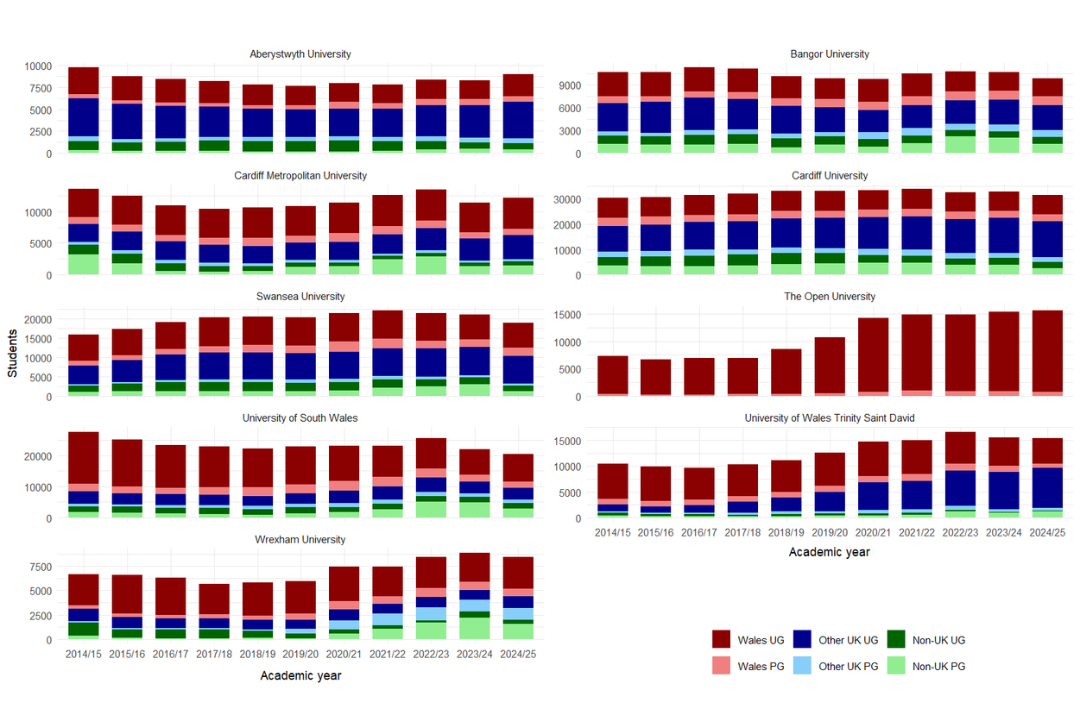
Figure 1: Student numbers by domicile and level
 Source: HESA Tables 28 and 59 and authors’ calculations
The years following Covid saw a dramatic increase in international postgraduate recruitment across much of the Welsh sector. This was part of what some have described as the ‘Boris wave’, following visa changes and the reintroduction of post-study work opportunities.
The crucial issue is not how many students pass through Welsh universities. It is where graduates build careers, establish businesses, raise families and contribute to public life.
Some universities embraced this strategy particularly aggressively. Cardiff Metropolitan University, the University of South Wales and Wrexham University experienced especially large proportional increases in international postgraduate recruitment. Swansea and Bangor also benefited significantly. Cardiff University, by contrast, appears to have been less reliant on this growth.
The problem is that international postgraduate recruitment proved vulnerable to policy changes outside Wales’s control. When UK immigration rules tightened, recruitment weakened.
In retrospect, the international boom looks less like a solution than a temporary offset to deeper structural problems. Universities were increasingly relying on globally mobile postgraduate students while continuing to face intense competition for domestic students, including students from Wales itself.
The picture becomes clearer when we look beneath the aggregate numbers.
Figure 2: Real income and expenditure by institution (2023 prices)
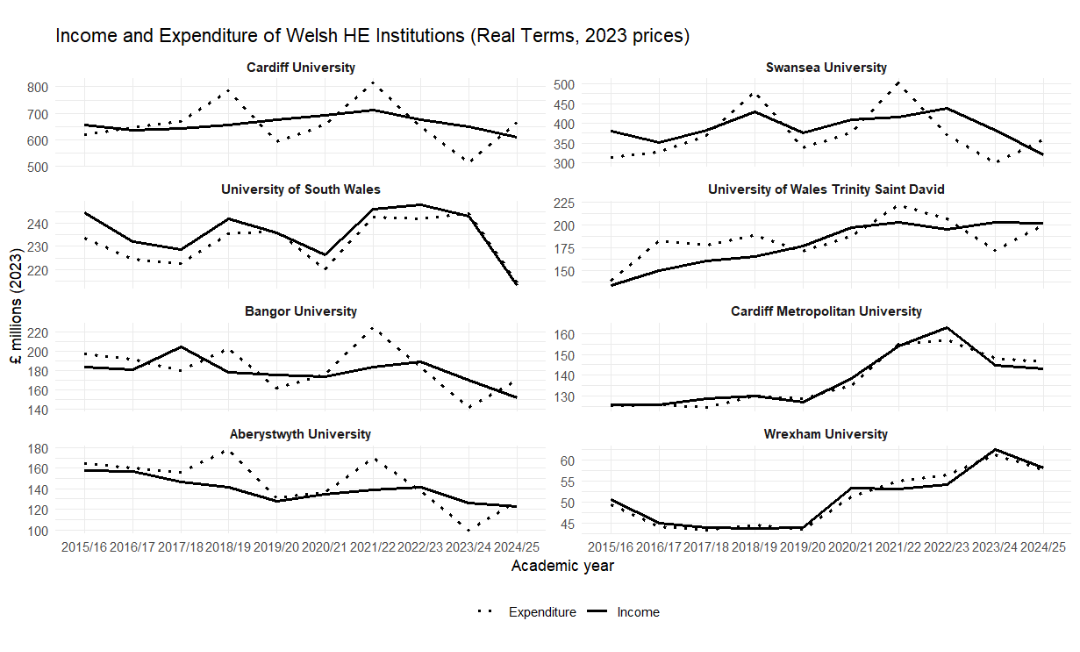 Note: much of the short-term volatility in expenditure for the ‘traditional’ universities relates to pension scheme revaluations, so it is better to focus on the longer-term trends in expenditure for these institutions.
Source: HESA Table 1 and authors’ calculations
Not all Welsh universities are experiencing the same pressures. In real terms, institutions such as Bangor and Aberystwyth have experienced a prolonged squeeze on income over the last decade. Swansea’s position has also weakened in recent years, while Cardiff University’s income growth has stalled.
By contrast, institutions such as Cardiff Metropolitan, Wrexham and the University of Wales Trinity Saint David have generally performed strongly.
Students who study in Wales are substantially more likely to work in Wales after graduation than Welsh students who study elsewhere.
This divergence matters. The institutions facing the greatest pressure are those that rely most heavily on attracting students from outside Wales and those that compete most directly for academically ambitious students. Bangor and Aberystwyth, in particular, have long depended on recruiting students from elsewhere in the UK.
The removal of undergraduate recruitment quotas in England in 2015/16 fundamentally changed that market. More selective English institutions were able to expand rapidly, intensifying competition for exactly the students that universities such as Bangor and Aberystwyth had traditionally attracted.
The result is that some of Wales’ most important civic institutions, and some of the largest employers in rural and Welsh-speaking areas, have found themselves particularly exposed to changes in the UK-wide market.
The impact is also visible in staffing patterns.
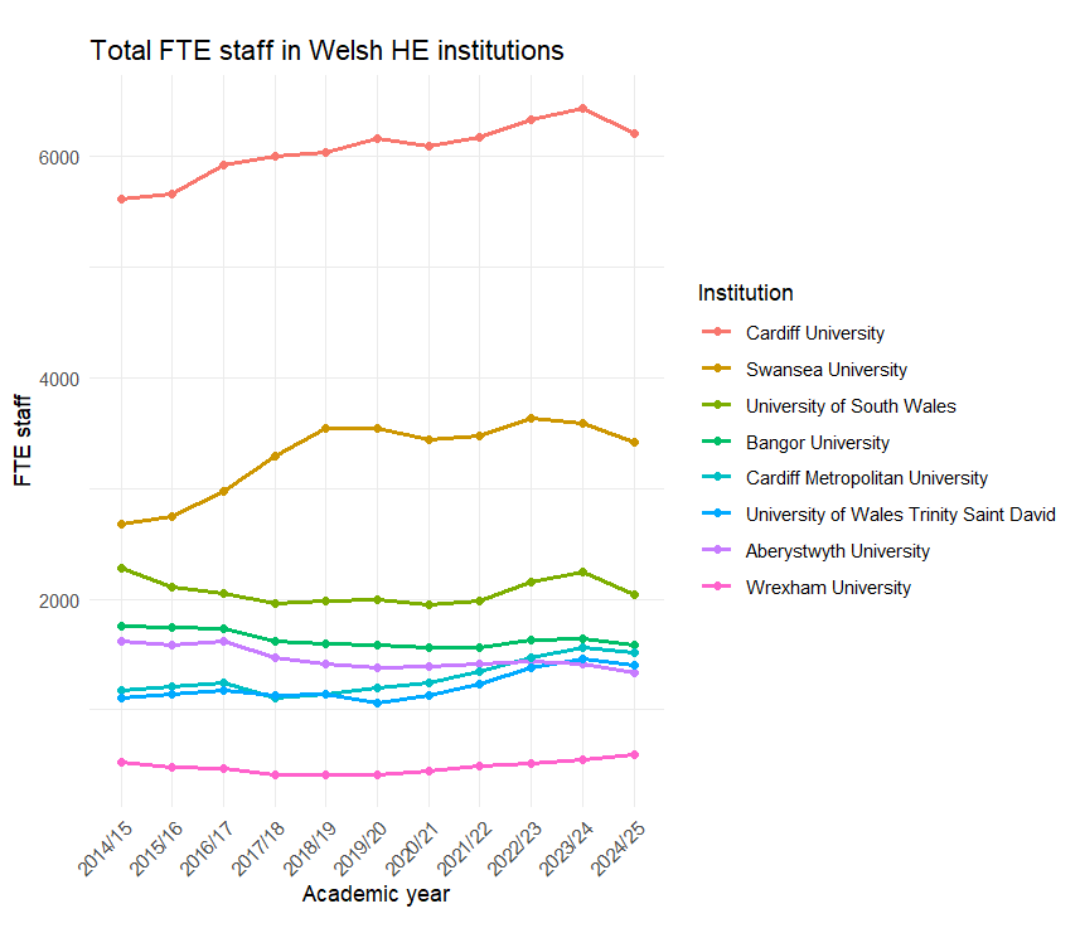
Figure 3: Staff numbers by institution (full-time equivalent)
 Source: HESA Table 6 and authors’ calculations
Over the last decade, staff numbers at Cardiff and Swansea grew substantially before recent retrenchment. Meanwhile, Bangor and Aberystwyth have experienced more consistent decline.
This is not simply a story about university finances. These institutions are major regional employers, anchor institutions, and important contributors to Welsh-language and cultural life. When they face sustained financial pressure, the consequences extend well beyond campus boundaries.
In short, the issue is not simply how many students Wales attracts. It is which students are being attracted, which institutions are attracting them, and how universities have adapted to a changing market. Wales may import students overall, but the institutions experiencing the greatest pressure are often those most exposed to losing high-attaining students and to shifts in recruitment patterns elsewhere in the UK.
If Welsh universities are struggling financially while Wales remains a net importer of students, perhaps student numbers alone are not telling us what we need to know.
Puzzle two: Why do so many Welsh students continue to leave Wales?
One of the most striking features of the Welsh higher education system is the persistent scale of outward student mobility.
Around a third of Welsh undergraduates study elsewhere in the UK. This is not new. What is interesting is where they go.
The largest category consists of students attending universities in the top quartile of the Complete University Guide. There is a clear story here. Since the removal of undergraduate recruitment caps in England, many higher-achieving students have increasingly gravitated towards elite institutions.
Universities such as Bangor and Aberystwyth play a particularly important role in sustaining Welsh-language professional networks and graduate opportunities.
Wales is unusually weakly represented in the most selective part of the UK university hierarchy. Cardiff University is currently the only Welsh institution in the top quartile of the Complete University Guide. If ambitious students are chasing prestige and rankings, some level of outward mobility is unsurprising.
But this is only half the story.
More than half of Welsh students leaving Wales are not attending top-quartile institutions. They are attending universities in the second quartile or the bottom half of the rankings.
Indeed, the three most popular destinations for Welsh students studying elsewhere are the University of the West of England (an average of 2,355 Welsh-domiciled students each year over the eleven years to 2024/25), the University of Chester (1,704) and Liverpool John Moores University (1,543). These are all institutions located relatively close to Wales and all sit in the bottom half of the UK university hierarchy.
Gofod i drafod, dadlau, ac ymchwilio.
Cefnogwch brif felin drafod annibynnol Cymru.
This suggests that two different forms of mobility are taking place simultaneously.
One group of students is pursuing prestigious institutions and appears relatively unconcerned by geography. Another group prefers not to travel too far from home.
These two patterns imply two different policy challenges. Students leaving for highly selective institutions may be responding to genuine differences in reputation, research strength and perceived career opportunities. For that group, the long-term answer may lie in strengthening Welsh universities themselves. Students attending less selective institutions just across the border present a different puzzle. Here, Wales already possesses comparable institutions. The question becomes whether a nation with limited public resources should remain entirely neutral between universities located in Wales and similar providers located elsewhere.
Figure 4: Welsh-domiciled students studying elsewhere in the UK
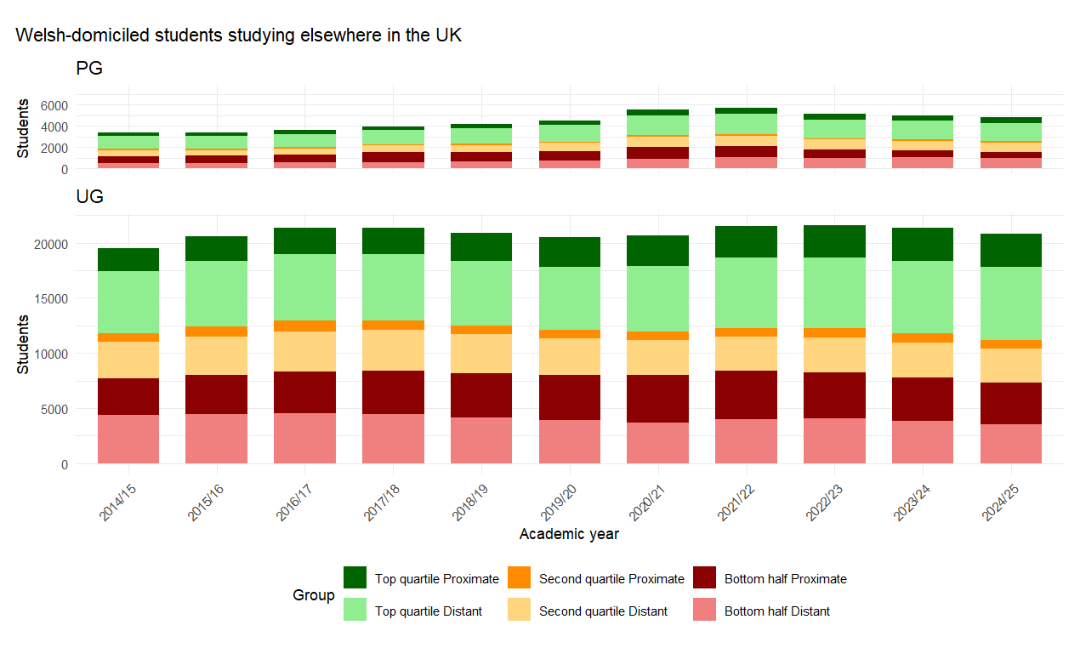
Note: Top quartile, second quartile and bottom half are based on the ranking of the destination university in the Complete University Guide. Proximate universities are those located within 50km of the border, with the remainder characterised as distant.
Source: HESA Table 6 and authors’ calculations
Puzzle three: Is Wales importing students but exporting talent?
This may be the most important puzzle of all.
The crucial issue is not how many students pass through Welsh universities. It is where graduates build careers, establish businesses, raise families and contribute to public life.
Research consistently shows that study location influences work location. Students who study in Wales are substantially more likely to work in Wales after graduation than Welsh students who study elsewhere.
That matters economically. It matters for public services. It matters for Welsh-speaking communities. Universities such as Bangor and Aberystwyth play a particularly important role in sustaining Welsh-language professional networks and graduate opportunities. And it matters for the long-term resilience of Welsh institutions.
A nation can attract students from elsewhere and still struggle to retain its own talent.
Indeed, one interpretation of current trends is that Wales is importing students while exporting a disproportionate share of its own future professionals, researchers and leaders. From a nation-building perspective, those two flows are not equivalent.
None of this implies that inward student mobility is undesirable. Welsh universities benefit enormously from attracting students from elsewhere in the UK and beyond. Those students contribute economically, culturally and academically to Welsh institutions and communities. The argument here is not for a more closed system. It is that Wales should think more carefully about the balance between attracting talent and retaining its own.
Two further questions
There are at least two additional issues worth considering.
The first concerns international students. The sector’s growing reliance on international postgraduate recruitment exposed Welsh universities to decisions taken in Westminster and to wider changes in global migration patterns. The ‘Boris wave’ demonstrated how quickly fortunes can change when institutions become dependent on revenue streams over which they have little control.
The second concerns the meaning of ‘student choice’. Advocates of the current system often emphasise the benefits of allowing Welsh students to study elsewhere. But Welsh student finance is not fully portable in any meaningful sense. It is largely portable within the UK.
If there are significant benefits from studying outside Wales, then why do those benefits apparently apply to Birmingham but not Dublin? To Edinburgh but not Amsterdam?
Public policy already draws boundaries around where Welsh financial support can be used. The real debate is not between freedom and restriction. It is about where those boundaries should lie.
A different way of thinking about student finance
Our SSRN working paper argues that student finance should not be viewed solely as an instrument for widening access. It is also an investment in future economic capacity.
When Welsh Government supports a student, the consequences extend beyond that individual’s degree. There are effects on university finances, local economies, graduate retention and, potentially, cultural and linguistic sustainability.
Our working paper develops a framework for thinking about these issues, not simply as questions of student choice, but as questions of investment, retention and long-run national capacity.
The paper explores a range of policy options. These include:
- a Welsh study premium;
- graduate retention incentives;
- additional support for Welsh universities recruiting Welsh students;
- Welsh-language and skill-shortage incentives;
- reforms to the portability of student support.
The purpose is not to advocate a single solution. Rather, it is to open up a debate that Welsh higher education policy has largely avoided.
The question is whether Welsh student finance should remain entirely neutral about where Welsh public resources are invested.
The real question is not whether students should be free to study elsewhere. They should be. Nor is it whether Welsh universities benefit from attracting students from the rest of the UK. They clearly do, and Wales should continue to welcome and encourage those students.
The question is whether Welsh student finance should remain entirely neutral about where Welsh public resources are invested. Should Welsh policy treat a year of study in Bangor, Bristol, Chester and Cardiff as equally valuable from the perspective of Welsh economic development, graduate retention and nation-building? Or should Wales begin to distinguish between them?
For too long, debates about higher education have focused primarily on participation and affordability while paying relatively little attention to where the wider economic, social and cultural returns ultimately accrue.
Student choice is often treated as an unqualified good. But governments intervene in markets all the time when individual choices produce wider social consequences. The question is not whether Welsh students should be free to study elsewhere. The question is whether Welsh public policy should be completely indifferent about where Welsh talent is developed.
That question matters for university finances. It matters for graduate retention. It matters for economic development. And it matters for the long-term future of Wales as a nation.
The current system treats these issues as largely irrelevant. Evidence suggests they are anything but.
Readers interested in the detailed evidence, modelling and policy scenarios can find the full working paper, Public Subsidy Leakage, Student Mobility and the Long-Run Sustainability of Welsh Universities, on SSRN. – Dr Rhys ap Gwilym, Dr Chrysovalantis Vasilakis, Rhanbarth Research Centre, Bangor University
All articles published on the welsh agenda are subject to IWA’s disclaimer. If you want to support our work tackling Wales’ key challenges, consider becoming a member.