Dr Arun Midha, Trustee at Street Child United, discusses the importance of Wales’ First Street Child World Cup
The Liberty stadium, home of Swansea City FC, has a capacity of 30,000. Now imagine 5,000 Liberty stadiums filled to capacity with over 150 million children. That is roughly the number of children living on the streets worldwide – whose reality consists of survival rather than safety.
In Wales, there are children who are street-connected in a broader sense: young people who, through no fault of their own, spend much of their time in unsafe, unstable environments, even if they have a home to return to. Many experience disrupted education, social isolation and heightened vulnerability. While their circumstances differ from children living in Favelas, Jhuggi-Jhopdi, or slums across the globe, the underlying challenges of insecurity, exclusion, and lack of voice are strikingly similar.
This is not simply a sporting event – it is a platform for children whose voices are rarely heard.
Supporting these young people requires more than compassion or a passing thought. They require opportunities, trusted relationships, and safe spaces where children can grow. That is exactly what Swansea City AFC Foundation and Blaenau Gwent Youth Service are doing in their respective communities. The Foundation and Youth Service support hundreds of children each year through mentoring, life skills programmes and inclusive community activities; helping them build resilience, confidence, and pathways to a more stable future.
Their work reflects the global approach pioneered by Street Child United (SCU), founded by Swansea born John Wroe (CEO of SCU). The charity uses the power of sport to give street-connected young people a platform to speak directly to those in power and drive lasting change.
Central to SCU’s work is the Street Child World Cup, held ahead of each FIFA World Cup. It brings together teams made of street-connected children from across the world to compete, create, and speak out on issues affecting their lives – from access to education, to protection from violence and gender equality.
This is not simply a sporting event – it is a platform for children whose voices are rarely heard. John Wroe’s inspiration for setting up SCU flowed from meeting a street-connected child in South Africa in the early 2000s who said: ‘When people see us by the side of the street, they say that we are street boys. But when they see us play football, they say that we are not the street boys. They say that we are people like them.’ This simple insight – that sport can give children dignity, identity, and visibility – has guided SCU’s approach ever since.
Syniadau uchelgeisiol, awdurdodol a mentrus.
Ymunwch â ni i gyfrannu at wneud Cymru gwell.
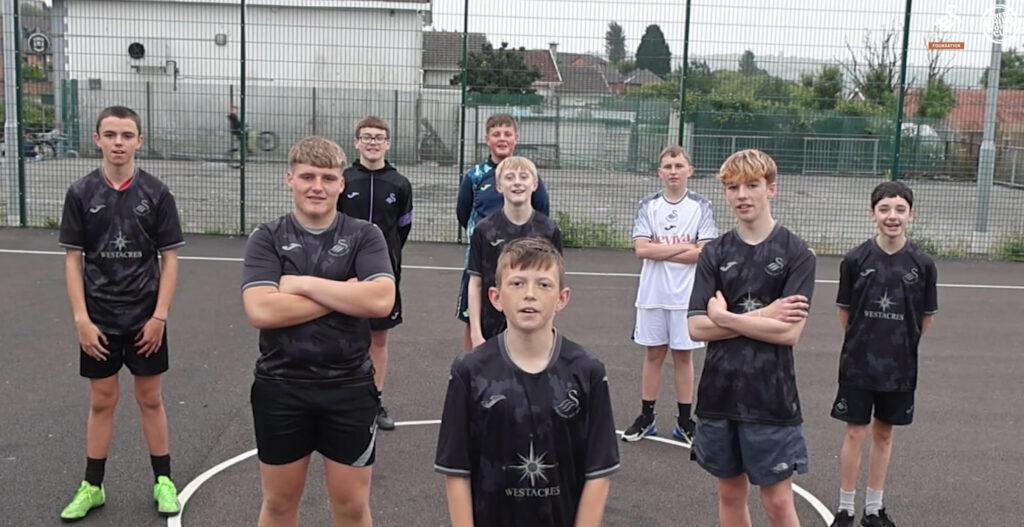
In May 2026, Wales will make history when a group of 10 boys from Blaen y Maes in Swansea and 10 girls from Blaenau Gwent will take the Foundation, and Youth service’s local work, onto the global stage – sending a powerful message about equality, inclusion, and children’s rights in action. In Mexico City they will be joining street-connected children from countries across the globe.
Team Wales (girls and boys), as they will be known, will be made up of young people, all of them Ambassadors for Wales, supported by the Swanse
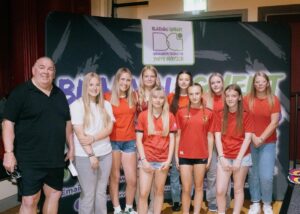
a City AFC Foundation, Blaenau Gwent Youth Service and Street Child United. In preparation for the event, Team Wales have been developing their football skills with some of the Swansea city team and have been guided by former Wales International goal keeper, Neville Southall. The children have also taken part in mentoring, training, and life skills programmes.
For the young people themselves, the opportunity carries enormous personal significance. Lilly-May York, a member of the Blaenau Gwent team, reflects: ‘This is a once-in-a-lifetime opportunity for us. We’re proud, we’re ready, and we can’t wait to represent our community in Mexico City.’
Alongside the football matches, participants will take part in a festival of arts in Mexico City and a child-friendly Congress at the United Nations. Here young people will get the chance to share experiences, build confidence, and speak directly about the issues shaping their lives. Beth Robinson (Targeted Interventions Manager at Swansea City AFC Foundation) emphasises that the initiative is about much more than sport: ‘This is about using football to create safe spaces where young people are listened to, trusted, and empowered on and off the pitch.’
Supporting Team Wales is not an act of charity – it is a statement about the kind of nation we aspire to be.
For the children, this experience will be as much about identity and belonging as it will be about sport. Wearing a Welsh badge in an international arena signals that their voices matter on a global stage, not just in their local communities. In giving them the trust to represent their country, they are being given the chance to be heard and valued.
The impact of that should not be underestimated. Moments like these can reshape how young people see themselves, what they believe is possible, and how they engage with education, employment, and their communities. It also teaches something profound to those who witness it: that children who face adversity on a daily basis have unique perspectives and capacities that can enrich our society.
Gofod i drafod, dadlau, ac ymchwilio.
Cefnogwch brif felin drafod annibynnol Cymru.
Supporting Team Wales is not an act of charity – it is a statement about the kind of nation we aspire to be. Wales has long positioned itself as a country committed to children’s rights, inclusion, and social justice, from the Well-being of Future Generations Act, to its commitment to the UN Convention on the Rights of the Child. Initiatives such as the Street Child United World Cup give practical meaning to those commitments. They signal to the world that Wales is willing to invest in young people at the margins, and that the values of fairness, solidarity, and empowerment are more than just words. They are lived practice.
In years to come, the young people of Team Wales may forget score lines, but they will never forget being seen, being heard, and being believed. That is the lasting impact of the Street Child World Cup and a reminder of how Wales’ policies, when paired with community action and investment in youth, can turn vision into reality.
All articles published on the welsh agenda are subject to IWA’s disclaimer. If you want to support our work tackling Wales’ key challenges, consider becoming a member.