
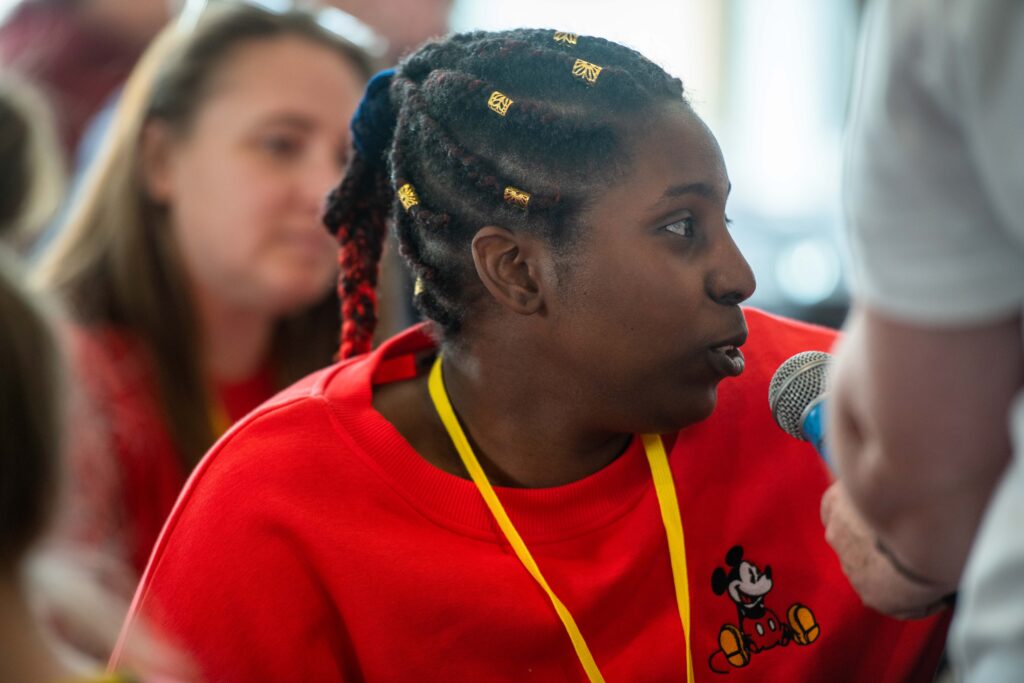
Edward Oloidi looks at the ways organisations can be more approachable and inclusive of people with learning disabilities from ethnic minority communities.
In an increasingly diverse Wales, ensuring that all citizens have a voice in the decisions that affect their lives is a cornerstone of a healthy, inclusive democracy. Yet for people with learning disabilities from ethnic minority and underserved communities, participation in civic life, including Self-Advocacy, remains uneven. While many are formally entitled to representation, they are often practically excluded from the very mechanisms designed to support them.
Central to this participation is Self-Advocacy. The Welsh Government defines Self-Advocacy as the process through which individuals represent and speak up for themselves. It is a cornerstone of the Social Services and Well-being (Wales) Act 2014. It enables people—particularly those with learning disabilities or care needs – to assert their rights, make informed choices, and challenge barriers to independent living.
Recent collaborative work between the Unit for Development in Intellectual and Developmental Disabilities (UDIDD) at the University of South Wales and All-Wales People First (AWPF) explored why this gap persists and what meaningful inclusion might look like in practice. Rather than assuming what communities need, the project centred on lived experience; bringing together people with learning disabilities to identify barriers and co-design solutions.
The findings suggest that the problem is not a lack of willingness to engage. Instead, the gap reflects a deeper mismatch between how services and participation structures are designed and how communities actually live, communicate, and build trust. Addressing this disconnect is essential if Wales is to realise its ambition of a genuinely inclusive civic culture.
The context of inequality
Wales is becoming more ethnically diverse, with ethnic minority residents accounting for approximately 5.9% of the population. However, this diversity is not yet reflected within many Self-Advocacy organisations, including those supported by local groups such as All Wales People First. Participation in these spaces remains disproportionately low among people with learning disabilities from ethnic minority communities.
In many cultures participation is a collective decision-making process. Consequently, outreach strategies that target the individual in isolation often fail because they ignore the significance of the wider family network.
Evidence suggests that the prevalence of learning disabilities among ethnic minority groups is broadly comparable to that of the wider population. Yet individuals from these communities often encounter multiple and overlapping forms of disadvantage. These inequalities arise from social and structural determinants. Factors such as poverty, inaccessible information, language barriers, institutional mistrust, and services that assume cultural familiarity with systems many families have never navigated before.
For individuals with learning disabilities, Self-Advocacy plays a crucial role in wellness. It is associated with improved wellbeing, increased independence, better access to services, and greater participation in education and employment. However, access to Self-Advocacy itself depends on understanding what it is, trusting who delivers it, and feeling culturally safe enough to participate.
This is precisely where current engagement approaches often fall short.
Syniadau uchelgeisiol, awdurdodol a mentrus.
Ymunwch â ni i gyfrannu at wneud Cymru gwell.
Listening first: co-producing a path forward
To address these disparities, our project adopted a participatory research model. Workshops were held with People First groups in Cardiff, Newport and Blaenau Gwent, using the Nominal Group Technique (NGT) — a structured method that enables participants to generate and prioritise ideas collectively. Importantly, participants were not asked how to “fix” themselves or their communities. Instead, they were asked what organisations needed to change.
What the findings tell us:
The findings from our participatory workshops suggest that the current under-representation of minoritised communities in Self-Advocacy is not merely a failure of communication, but a fundamental misalignment in the relationship between organisations and families.
A primary insight is that for many participants the family unit serves as the essential gateway to engagement, rather than a barrier to individual autonomy. In many cultures participation is a collective decision-making process. Consequently, outreach strategies that target the individual in isolation often fail because they ignore the significance of the wider family network. Trust in this context is not built through formal recruitment campaigns, but through “relational travel”—informal meetings, family awareness sessions, and the recognition of parents and siblings as partners in the advocacy journey.
Moving beyond tokenistic participation requires prioritising relationship-based outreach over short-term, project-led engagement.
Furthermore, accessibility must be inclusive of cultural dynamics. While Easy Read materials remain a cornerstone of disability support, they are insufficient if they do not account for factors such as limited English proficiency, digital exclusion, or a community preference for oral storytelling. True accessibility, therefore, requires a shift toward multi-format, culturally relevant communication, such as translated audio and community-led videos, that meet people in their own everyday spaces – from GP surgeries to religious venues. The data suggests that “presence” carries more weight than “promotion.”
Ultimately, the study highlighted that trust is best fostered through people rather than institutions. The identification of “community ambassadors” – individuals with lived experience who can speak with authority within their own networks – reframes outreach from organisational self-promotion to community ownership.
This shift is essential for reaching the most marginalised – such as those connected to refugee or asylum services – where cross-sector partnership is not an optional enhancement but a necessary condition for inclusion.
From participation to policy action
These findings resonate strongly with the Well-being of Future Generations (Wales) Act (2015) and the Anti-Racist Wales Action Plan, which advocate for a more equal and globally responsible Wales. However, policy commitments alone do not automatically change lived experience.
The study demonstrates that exclusion often emerges unintentionally from service design assumptions — particularly the assumption that individuals will approach services independently and that information alone creates engagement. Instead, engagement is relational, cultural and local.
In practical terms, this means inclusion cannot be achieved through translation alone or occasional outreach initiatives. It requires re-designing how organisations understand community entry points.
Why this matters
Improving representation in Self-Advocacy organisations is not only about fairness. It affects policy quality.
When some groups are absent from consultation and engagement processes, public decisions reflect only partial experience. This can widen inequalities in health, housing, education and social care — even when policies aim to reduce them.
By diversifying membership in organisations like All-Wales People First, Wales strengthens democratic participation itself. People with learning disabilities from all backgrounds gain the opportunity to influence services they use daily.
Inclusion, therefore, is not a specialist issue. It is a governance issue.
Gofod i drafod, dadlau, ac ymchwilio.
Cefnogwch brif felin drafod annibynnol Cymru.
Policy recommendations
The evidence gathered through this project points toward a necessary shift in how the Welsh Government, local authorities, and third-sector leaders approach engagement with minoritised communities. Moving beyond tokenistic participation requires prioritising relationship-based outreach over short-term, project-led engagement. This means resourcing staff time specifically for the slower but essential work of building trust with families and community leaders.
The central message of this work is simple but profound: people are not hard to reach — systems are often hard to approach.
A modernised engagement framework must also redefine accessibility. Rather than relying primarily on written Easy Read materials, organisations should adopt multi-pathway communication strategies that combine digital outreach with traditional media such as local radio and community press; ensuring both younger audiences and older carers can be reached. In addition, the role of lived experience must be formally recognised in commissioning processes by funding peer advocates from minoritised backgrounds to serve as community ambassadors.
Finally, for these changes to be sustainable, Self-Advocacy should be recognised and protected as a “preventative service” within statutory frameworks. Embedding Self-Advocacy within formal engagement structures would help safeguard these initiatives from shifting political priorities. Strategic partnerships between disability services and immigration, refugee, and settlement organisations should also become standard practice.
Ultimately, meaningful inclusion depends not simply on counting who attends consultations but on identifying who is missing from the table. Only by addressing these gaps can Wales ensure that public decision-making reflects the full diversity of its citizens’ experiences.
Towards a more inclusive Wales
The central message of this work is simple but profound: people are not hard to reach — systems are often hard to approach.
For Wales to become a genuinely inclusive nation, Self-Advocacy must be accessible in everyday practice, not only in policy commitments. This requires engagement strategies grounded in trust, community presence, and cultural understanding — particularly recognition of the central role families often play in supporting participation.
For policymakers and third-sector leaders, the message is clear: “one-size-fits-all” engagement strategies often inadvertently exclude the very people they aim to serve. To foster true inclusion, we must anchor our efforts in the community, respect cultural nuances, and ensure that information is truly accessible to all. Only then will inclusion move from policy ambition to lived reality.
All articles published on the welsh agenda are subject to IWA’s disclaimer. If you want to support our work tackling Wales’ key challenges, consider becoming a member.