Kaja Brown discusses the recent heatwaves and what Wales can do about the climate crisis
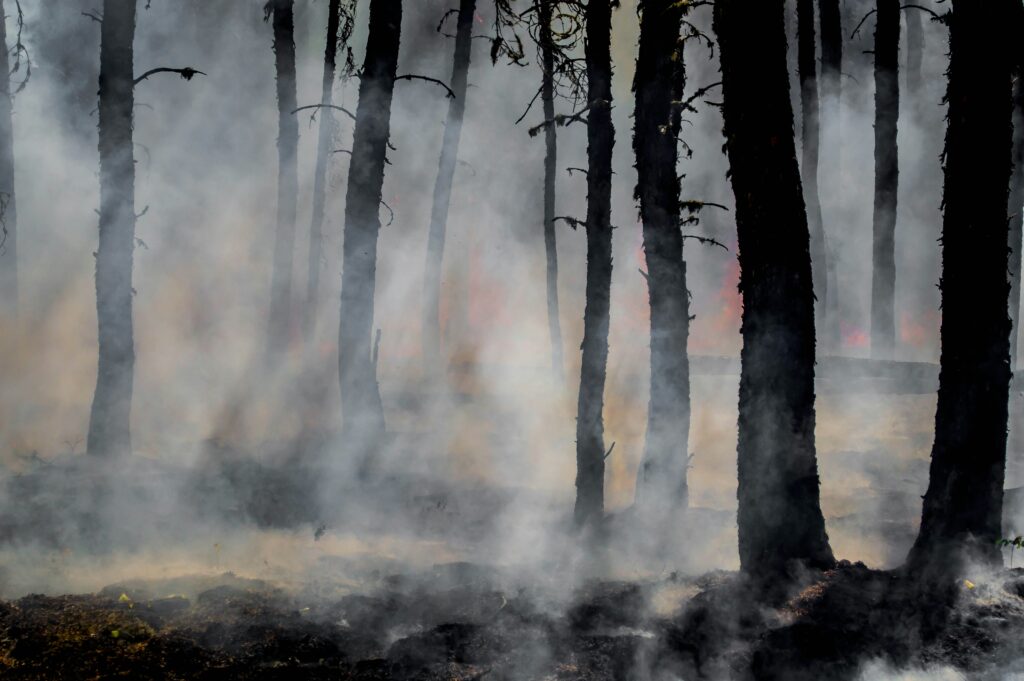
This summer has been extremely hot. In Wales we have experienced several record-breaking heatwaves, with deadly results. Around 2,700 people in England and Wales have died due to the heatwaves, with an average of 440 people dying a day during the peak of June’s extreme heat. Meanwhile, water shortages have led to widespread hose-pipe bans, and a drought status came into effect across all of Wales. We have also witnessed wildfires across the UK, and some major incidents in both north and south Wales. Although some forest fires are caused by human activities – such as discarded cigarettes, campfires, and arson – these fires are more likely to catch and spread widely due to plants and bracken that have been dried out during heatwaves.
It is a particularly sobering thought that this is likely to be one of the coolest summers of the rest of our lives.
This summer paints a worrying picture of what our future may look like, as temperatures continue to rise. It is a particularly sobering thought that this is likely to be one of the coolest summers of the rest of our lives.
This first-hand evidence of climate change is compounded by a widely circulating partially-released* report that has found that the collapse of ecosystems overseas could have catastrophic consequences for the UK’s national security. According to the Guardian:
‘The report paints a devastating picture of severe food shortages, price rises, migration, political destabilisation and possible war, resulting from the collapse of ecosystems, fuelled by the human-induced climate crisis and over-exploitation.’
*Despite MPs and citizens asking for the full version of the report to be released, this has not yet occurred, leaving us partially in the dark at time of writing around its substantive content.
The report states that extreme food shortages could occur within the next five years. What does that mean for Wales – a country that has some of the worst poverty levels in the UK, where around a quarter of families with children already face hunger?
Water shortages, food shortages, forest fires, deadly heatwaves – these are not problems we can wait to act on. This is a national (and international) emergency that warrants urgent action. So what are the Welsh Government doing about it?
The Welsh Government on the climate crisis
In 2019, the Welsh Government declared a climate emergency. The then minister for Environment, Energy and Rural Affairs Lesley Griffiths said:
‘We hope that the declaration by Welsh Government today can help to trigger a wave of action at home and internationally. From our own communities, businesses and organisations to parliaments and governments around the world.’
Alongside this declaration, the (then Labour) Welsh Government committed to achieving ‘a carbon neutral public sector by 2030’, and coordinating action ‘to help other areas of the economy to make a decisive shift away from fossil fuels, involving academia, industry and the third sector’.
In March 2021 the Senedd approved a net zero target for 2050. There have been some setbacks and protests since this goal was set out, and it is a contested issue whether or not Wales is on track to meet this target, with some reports suggesting that Wales will not meet its net zero target at the current trajectory.
Wales sits at 224 out of 240 countries on the Biodiversity Intactness Index, putting us, alarmingly, in the bottom 10%.
Also in 2021, the Welsh Government declared a nature emergency. Biodiversity loss and climate change go hand in hand, as climate change worsens the loss of natural resources, whilst, conversely, restoring natural ecosystems can store carbon and improve climate resilience. Despite this, the nature emergency declaration hasn’t seemed to have produced tangible results. Wales sits at 224 out of 240 countries on the Biodiversity Intactness Index, putting us, alarmingly, in the bottom 10%. Since it is the collapse of ecosystems that had been linked to catastrophic climate outcomes, tackling biodiversity loss is something the new Welsh Government ought to prioritise, alongside net-zero goals.
Things have not remained stagnant since these major declarations. Earlier in 2026, the previous Welsh Government passed The Environment (Principles, Governance and Biodiversity Targets) (Wales) Bill. This Bill commits to legally-binding biodiversity targets and introduces a new watchdog who will be responsible for holding public authorities to account on environmental law. This bill is a welcome sign of progress when it comes to taking biodiversity loss seriously. New environmental targets and governance are vitally important, but they need to be underpinned by the resources and actions needed to halt biodiversity loss.
Every action we take, every decision we make, involves other countries and other ecosystems.
All of these bills, targets and declarations were made under the Welsh Labour Government. For the first time in Welsh history, we now have a Plaid Cymru government. What are Plaid’s goals for a greener Wales? Plaid started off strong in their 2024 general party manifesto, saying they would achieve net-zero by 2035 (fifteen years sooner than Labour’s target and Wales’ legally mandated target). However Rhun ap lowerth has since dropped this party pledge, claiming that it ‘isn’t realistic’. They do still have some strong climate goals though. As outlined in their ‘100 Day Plan’, they want to ‘Commence work on an updated Climate and Nature Action Plan for Wales, focused on charting a practical pathway to net zero by 2040 and substantive nature recovery by 2050’, prioritise renewable energy, and begin a National Food Strategy. These goals sound promising on paper, but it will be interesting to see how they are delivered.
Reform, the Welsh Government’s main opposition party, famously question the legitimacy of the human-made climate crisis (despite the science). They outlined in their 2026 Welsh manifesto that they wish to scrap net-zero goals, ban new onshore wind and solar farms, and abolish Natural Resources Wales. As such, this could make it difficult for Plaid to move forward with their climate goals, unless they are able to get support from other parties, an issue common with being a minority government.
Still, it looks like Plaid’s plans are a step in the right direction. But is it enough when it is the collapse of ecosystems on a global scale that threatens our future security?
Syniadau uchelgeisiol, awdurdodol a mentrus.
Ymunwch â ni i gyfrannu at wneud Cymru gwell.
Wales on a global scale
Although it is critical that we do our best to reverse Welsh biodiversity loss and meet our net zero targets as soon as possible, it would be a massive oversight not to consider international climate issues. Wales’ emissions are a drop in the ocean when it comes to our global greenhouse gas emissions.
The top five greenhouse gas emitting countries* are China, the USA, India, the EU, and Russia. *(Climate Watch classes the EU as a country in this statistic). I would like to add the caveat that it is hard to point fingers and play a blame game based on these figures alone. Even though China and India are currently big polluters, historically the US and the EU has done more damage to the climate. Furthermore it has been argued by Friends Of the Earth that the pollution coming from places like China are often caused by big factories which create goods that are imported to the UK and US, who have massive overconsumption problems. FOE argues that this means: ‘their pollution is in fact our pollution’.
I believe this gets to the crux of the matter. In our society, we are obsessed with borders; these invisible lines that divide territory and responsibility. But nature doesn’t really work that way. The Earth is an interconnected web of ecosystems that spans the globe. Take the Amazon rainforest as an example. The Amazon rainforest is a unique habitat which is crucial when it comes to climate change. It is also sadly reaching its tipping point due, primarily, to illegal logging, mining and human exploitation. The Amazon spans eight different countries: Brazil, Bolivia, Peru, Ecuador, Colombia, Venezuela, Guyana, and Suriname. Thus, cooperation between governments is crucial for the conservation of the region.
Maybe this is the way forward. Organisations in Wales working collaboratively on ecosystem restoration and net-zero climate goals on both a local and global level.
Every person in Wales is part of an interconnected web which crosses borders. We might buy coffee from Columbia, get clothes from China, source our furniture from a certain Swedish company. Our textile waste ends up in Ghana, the water bottle you accidentally left on the beach might end up in the Sargasso Sea. Every action we take, every decision we make, involves other countries and other ecosystems. This is part of why we have a global responsibility to the climate. We are all in this together.
We must act to do everything within our power to reduce our own emissions and improve biodiversity – but this cannot work in isolation. We need to be active on an international scale. How we achieve this, though, is complicated.
Earlier this year the UK government announced that it will cut climate aid to developing countries by 14%, to £2bn a year. This Foreign Aid budget is a reserved issue, it is not something our devolved government can do much about. However, it is possible that the Welsh Government could try and put pressure on the UK government to rethink this decision – perhaps by teaming up with other countries like Scotland. However, it is sensible to know the limits of the Welsh Government’s influence on reserved issues.
Perhaps, in this case, we need to look past the scope of the Welsh Government and look to other places for answers. We have several organisations local to Wales that are working on global climate action.
For example, Size of Wales works ‘with Indigenous People and local communities in Latin America, Africa and South East Asia to secure and sustain an area of tropical forest at least the size of Wales, and grow millions of trees.’ This work includes the Amazon rainforest, which is vital to the Earth’s climate and nature equilibrium. Meanwhile, Project Seagrass works on seagrass conservation in Wales and globally.
Maybe this is the way forward. Organisations in Wales working collaboratively on ecosystem restoration and net-zero climate goals on both a local and global level.
Wales’ responsibility to the planet
We are living on the very cusp of numerous global tipping points. The science is clear. If we do not act now then we risk food shortages and security issues within five years. We are already getting a taste of it this summer, with wide-spread fires, heatwaves and water shortages. This is a matter of national (and international) security and an issue that Wales must prioritise, for the sake of future generations.
It is also critical that we acknowledge our part on a global scale and work together – nationally and internationally – to make this work.
All articles published on the welsh agenda are subject to IWA’s disclaimer. If you want to support our work tackling Wales’ key challenges, consider becoming a member.