Jess McQuade, Senior Programme Manager for WWF Cymru’s Pembrokeshire Wholescape, explains how the ‘science of hope’ has helped people in Pembrokeshire look past today’s challenges and imagine a hopeful future for their river.
“They call this part of me Llygad y Cleddau, the Eye of the Cleddau. Sheep and ponies graze up here, sometimes joined by cattle, in a way that works with nature rather than against it. Trees and bushes cling to the hillsides; birds nest in the heather.”
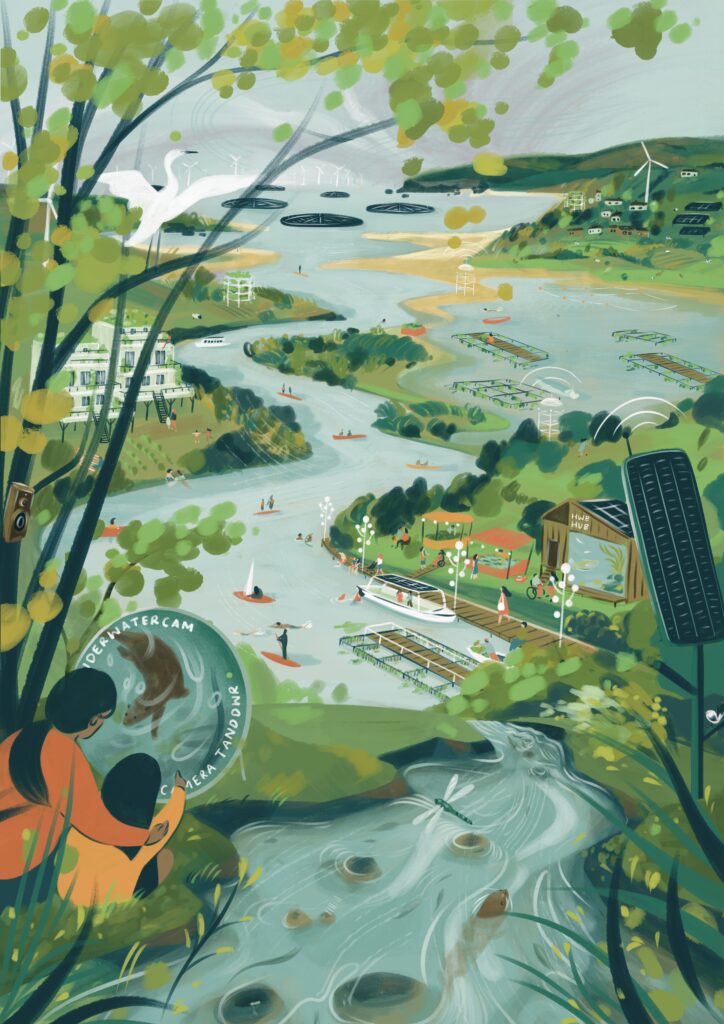
“At Picton point we become the Daugleddau – the two Cleddaus, one water. From here I am busy with electric boats, and the machinery in the portside industry runs on electricity from the turbines that float out at sea. The landscape has more people living in it now, including in multi-occupancy dwellings, close to their sources of food, water and renewable energy. Yet I still have space and lots of habitat for nature to thrive. Salmon swim unobstructed through the Daugleddau Estuary to reach their spawning grounds up the rivers. Seagrass meadows support all sorts of life, and the once legendary native oysters are back, after changes to land practices upstream cleared me of sediment and nutrients.” From ‘Story 1: Pembrokeshire’, The Good Anthropocene report, pp. 19-20.
These issues are deeply felt by local people, and they show how our wellbeing cannot be separated from the wellbeing of nature.
This is the river speaking – or rather, the river as imagined by the people who live alongside it. In April, statutory organisations, community members, farmers, social enterprises and an artist came together in Haverfordwest, with the Future Generations Commission and the University of York, to share their long-term vision for the Cleddau.
The Cleddau, and all the landscapes it touches, faces enormous environmental, social, economic and cultural challenges. It is a Special Area of Conservation that is failing, and the iconic species that make it special are in decline. The most visible current sign is water pollution, which is stalling much-needed housebuilding in the county. These issues are deeply felt by local people, and they show how our wellbeing cannot be separated from the wellbeing of nature.
Complex, interconnected challenges need a joined-up response. WWF is piloting an approach that treats nature as connected across land, rivers, coasts and seas, and that tackles the social and economic drivers of decline. The Pembrokeshire Wholescape is one of three such areas in the UK, alongside Norfolk and the Firth of Forth. Our goal is to show that working across a whole ecosystem – at a larger scale, with long-term thinking – leads to lasting positive change for people and nature.
Innovative. Informed. Independent.
Your support can help us make Wales better.
WWF UK and the Leverhulme Centre for Anthropocene Biodiversity at the University of York used the three Wholescapes as a test bed for The Good Anthropocene project. Workshops in each place asked people how future generations might adapt to a changing landscape and climate – but above all, what future they want. As part of this process, we asked people to imagine a good future over the lifetime of a child born today – around 80 years – and then seven generations ahead, some 160 years.
Each workshop produced a vision unique to its place. In Pembrokeshire, we focused on a vision for the Cleddau. The resulting story is a lyrical meditation narrated by the river itself as it winds through a landscape both familiar and very different. It sets out a vision for farming and for food, energy and housing systems – a place in which the wellbeing and livelihoods of communities are deeply connected to each other and to nature. Jasmine Hortop’s artwork distils the story into a single, uplifting image that makes the vision feel tangible and within our grasp.
The resulting report, The Good Anthropocene: The Science, Community and Art of Hope, complements WWF’s 2026 Living Planet Report, whose ‘science of hope’ stresses the importance of ‘positive tipping points’ – the idea that small changes can add up until a system tips and a positive trajectory becomes self-reinforcing.
Our goal is to show that working across a whole ecosystem – at a larger scale, with long-term thinking – leads to lasting positive change for people and nature.
We are exploring how we reach these positive tipping points in our Wholescape areas. We identified three core shifts in thinking that need to take place:
- From silos to systems: from short-term, siloed, linear thinking to a worldview based on interconnected social-ecological systems and long-term thinking.
- From fatalism to agency: from a disempowered, fatalistic mindset to one of optimism, agency and co-operation.
- From extraction to stewardship: from destructive extraction to stewardship and shared governance of nature and the environment.
WWF Cymru is utilising the vision created for the Cleddau, and the positive tipping points approach. For example, a core element of our work is supporting the development of the Cleddau Catchment Partnership, so the Good Anthropocene vision can be used as the future partners are working towards. We are supporting the development of many other projects, bringing investment into the area, which together will help regenerate the Cleddau from source to sea.
Robust debate and agenda-setting research.
Support Wales’ leading independent think tank.
WWF also sees this approach and The Good Anthropocene project as an example of the Well-being of Future Generations (Wales) Act 2015 in practice: long-term, integrated thinking, developed collaboratively and involving the people who live alongside the river. We welcomed the Future Generations Commission’s help in shaping the visioning approach for the day, and hope this is a model that can be applied elsewhere in Wales.
We can’t return to the past, and the present can leave us anxious and hopeless. This project has shown that, with the right tools and governance in place, hope for a better future can emerge.
You can find out more about the Good Anthropocene project and access both Welsh and English versions of the report here: The Good Anthropocene: How we think about the future | WWF
To learn about our Pembrokeshire Wholescape Programme visit: Pembrokeshire Wholescape | WWF
All articles published on the welsh agenda are subject to IWA’s disclaimer. If you want to support our work tackling Wales’ key challenges, consider becoming a member.