

Jack Wilkinson-Dix asks how Wales’ new government should respond to a rapidly growing – and increasingly contested – industry
A large crowd packs out a small town hall, eyes fixed on the three men sat at a trestle table at the back of the room, adorned with an American flag. As the meeting reaches a crescendo amid angry interjections from the audience, many of whom carry signs warning of pending ecological destruction, one of the seated men angrily tells the assembled crowd ‘For hell’s sake, grow up’. The reaction is instant, with howls and boos from the townsfolk – some of whom are escorted out by security. Eventually, the three men are forced to leave for a dimly lit meeting room where the rest of the planning meeting is conducted behind closed doors, over a live camera feed, with comments turned off. They ultimately vote in favour of the proposed project. Within 3 months two of the men have been voted out with a separate state legislator also falling foul of local opposition to the project.
The unrestrained expansion of data centres could jeopardise Welsh and UK climate goals, as their operation increases our energy demand and puts strain on the environment.
These events took place between May and July this year in Box Elder County, Utah. The seated men were the three County Commissioners, whose role is to oversee planning decisions, and the project that generated such burning animosity was the proposed 40,000 acre Stratos data centre project. If it had gone ahead as originally proposed, it would have required 8GWs of electricity – double the peak usage of the entire state of Utah. When conceding their election races, both the departing Commissioners explicitly stated that opposition to the data centre had led to their ousting. And opposition appears to be growing. Polling suggests 75% of Americans would oppose a data centre in their local area and there are 580 local opposition groups across nearly every U.S. state, totalling over 640,000 members.
Data centre growth in Cymru
It isn’t hard to imagine similar scenes playing out in Wales as the global march of data centre construction reaches Cymru. We are already seeing prominent data centre proposals generate local backlash and trigger national headlines. One such proposal is Maska Group’s planned 21,480m2 data centre in Pontyclun. The company plans to develop the data centre on agricultural land and local opposition has been fierce, citing concerns around the site’s significant energy use (and resultant grid impacts), habitat destruction, requirements for fresh water, and noise impacts on residential areas. These concerns are echoed by local residents at another proposed site, this time in Llanrumney, Cardiff, where the mooted site is currently used as a park and ride facility for University of South Wales Hospital and has been opposed by the local branch of the Acorn tenants union.
Plaid must also be conscious that every data centre given preferential treatment in the electricity connection queue is potentially bumping down a new housing development, school, hospital or infrastructure project which could offer stronger benefits to local communities.
The significant energy and water use associated with data centres has been a consistent concern from opposition groups. There are now 80GWs of data centre applications in Ofgem’s electricity connections queue; double Great Britain’s typical peak electricity demand. The regulator is sufficiently concerned to have launched a consultation on how to deal with speculative data centre grid applications. These concerns feel especially poignant in the UK where many regions face significant water stress (highlighted as never before during the multiple 2026 summer heatwaves), limited fresh water storage, and an energy grid pipeline that is often congested, with among the highest electricity bills in Europe.
Grid congestion and connection delays are a particular issue in Wales, and as data centres vie for a prominent place in the connections queue, lessons from the US should give us cause to pause. In several US states, data centre developers, frustrated with planning laws and long wait times to connect to electricity grids, have instead opted to develop their own on-site energy generation. While this can seem appealing from a grid management perspective, because data centres require constant supplies of electricity, in practice, this has often resulted in developers constructing off grid gas-fired turbines with limited regulatory oversight – increasing both carbon emissions and pollution. Perhaps the most egregious example of this is Elon Musk’s xAI Colossus 2 data centre in Memphis where 59 gas turbines were installed without securing permission from local regulators. It is suggested that the environmental impact of these turbines has disproportionately impacted predominantly Black neighbourhoods.
Wales should take heed of these warnings. In the Llynfi Valley, a Texas-based company is proposing to develop a Small Modular Nuclear Reactor (SMR), with rumours locally that one potential use for the electricity generated could be to power a new data centre at the nearby former Ford factory site. Similarly to the Welsh data centre proposals above, local opposition to Last Energy’s SMR has been strong, with concerns around: safety and the proper disposal of waste; Last Energy’s track record (given they have never built an SMR and pushed for decreased federal safety oversight in the US); water requirements for the reactor (though Last Energy have been keen to promote their closed loop cooling system); and questions around the number of jobs for local people. The parallels with the concerns surrounding data centre developments are considerable.
Innovative. Informed. Independent.
Your support can help us make Wales better.
The Challenge for Welsh Government
With the UK Government designating much of north and south Wales as AI Growth Zones (AIGZ), Wales having the highest data centre capacity outside London, and several data centres being expanded or proposed, the new Plaid Cymru Government will have to set out their stance quickly.
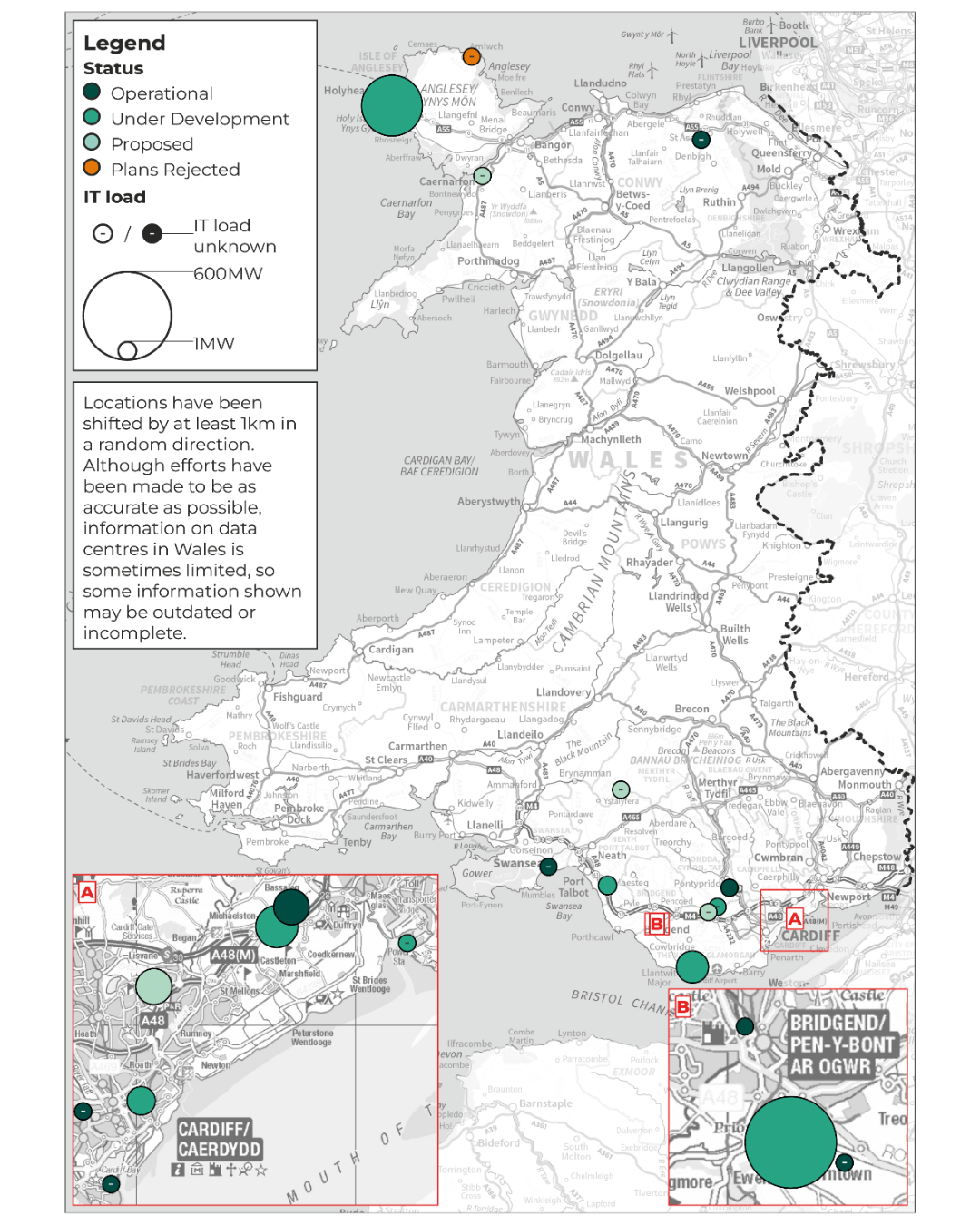
Recent Senedd research suggests the economic benefit from hosting these sites could be significant; the UK Government predicts £10bn of investment in the south Wales AIGZ and 8,400 jobs across Wales from the building and operation of data centres (though these figures are strongly contested). Plaid Ministers will no doubt be being painted a positive picture of what these developments can offer a cash-strapped Cymru.
The optics of foreign-owned companies drawing on Wales’ natural resources (water, especially) to generate profits which are likely to be siphoned off elsewhere is also clearly a challenge for Plaid.
On the other hand, it is not hyperbolic to say that the unrestrained expansion of data centres could jeopardise Welsh and UK climate goals, as their operation increases our energy demand and puts strain on the environment. Plaid must also be conscious that every data centre given preferential treatment in the electricity connection queue is potentially bumping down a new housing development, school, hospital or infrastructure project which could offer stronger benefits to local communities.
Some Plaid MSs have already begun to voice their opposition to specific data centre proposals (e.g. Kiera Marshall MS) but the Party itself has not set out their public position to-date. The clearest signal has been the issuance of a ‘holding directive’ from Welsh Government for the University of South Wales Hospital park and ride site. This prevents Cardiff Council from granting planning permission itself and gives ministers time to decide whether to call in the application and decide on the outcome of the planning decision itself. The issue of data centre development has echoes of another contentious policy area for Plaid – nuclear power. Here, again, are significant infrastructure projects which offer the potential for local employment and economic growth (a la Wylfa) but face significant opposition for their environmental impact. The optics of foreign-owned companies drawing on Wales’ natural resources (water, especially) to generate profits which are likely to be siphoned off elsewhere is also clearly a challenge for Plaid.
Discussions and debates that drive Wales forward.
Join Wales’ leading independent think tank.
Plaid may want to consider an approach similar to the model being developed in Australia. The Australian government is proposing a set of ‘bring your own power’ laws for data centres which would require them to:
- Procure 100% renewable electricity from additional generation
- Fully meet their grid connection costs and any water infrastructure costs
- Secure firming capacity (essentially, proving their demand is backed by generation)
- Provide grid flexibility services
- Respond to locational pricing incentives
While many of the powers to implement the above proposals are not devolved, Plaid should consider adopting these principles, work to implement what they can through planning (which does not make explicit reference to data centres, unlike in England and Scotland) and push the UK Government and Ofgem to adopt the same. The lesson of Box Elder County is that getting this wrong can be disastrous.
All articles published on the welsh agenda are subject to IWA’s disclaimer. If you want to support our work tackling Wales’ key challenges, consider becoming a member.