Geraint Talfan Davies explores the history of English devolution in response to Andy Burnham’s speech
In the art of communication it would be hard to think of a greater contrast than that between Andy Burnham’s agenda-setting address and the speeches of the outgoing Prime Minister, Sir Keir Starmer: the Manchester location, the black tee-shirt rather than a grey suit, a lectern with no pithy slogan on its front, and a backdrop of two industrial doors rather than the stately panelling of Westminster or No. 10.
There will be plenty of questions to be asked about the specifics of Burnham’s speech – not least about its financial implications – but for those who have complained about the current government’s inability to ‘tell a story’, it must have come as a blessed relief. Whether or not it turns out to be the ‘circuit-breaker that Britain needs’, it certainly laid down a whole series of tests against which a future Burnham government will be judged.
It is difficult – if not impossible – to recall a speech by an English politician that had such a resolutely decentralist tone: the emphasis on ‘place’ rather than ‘politics’, its direct criticisms of Parliament and Whitehall, its rejection of ‘the old trickle-down model’, and its citing of Germany’s Basic Law, with its protection of the 16 constituent states that make up the Federal Republic.
Innovative. Informed. Independent.
Your support can help us make Wales better.
Unsurprisingly, his announcement that he would create a No. 10 office in Manchester was greeted with wild applause by his Manchester audience, but we have yet to see what that will entail. For instance, what relationship would it have with the Darlington Economic Campus now under construction in the north-east of England, and intended to house sections of the UK Treasury and parts of no less than eight other UK government departments? How, too, would the Manchester No. 10 office relate to the three devolved Parliaments?
In all this, Wales is not a disinterested party. With its long eastern flank facing England, and four major English cities – Manchester, Liverpool, Birmingham and Bristol – not far from its borders, Wales has much stake. It will also be interesting to see how Burnham’s approach and proposals will affect the currently prickly relationship between the Welsh Government and the Secretary of State for Wales. One is also driven to ask whether Wales’ seeming difficulties in enhancing its own constitutional arrangements are a by-product of the hitherto timorous approach to England.
It will be interesting to see whether, once he is installed in No. 10, Burnham will make the difference that he promised this week.
Although the test will come when Burnham’s proposals run up against civil service scepticism and the political forces of the south-east of England, at least devolution is now part of England’s agenda. It was not always thus.
More than half a century ago devolution was regarded as a subject for Celtic obsessives, best indulged by consenting adults in private. In the 1960s, in the wake of some by-election successes by Plaid Cymru and the SNP, Harold Wilson’s government set up a Royal Commission on the Constitution that proposed legislative assemblies for Scotland and Wales.
However, given the commission’s origins, it was not surprising that its report and proposals had comparatively little to say about England, the union’s largest country by a country mile. That was left to a memorandum of dissent by two of its members.
Half a century later, Scotland and Wales have their own Parliaments, catching up with Northern Ireland that had had a Parliament – albeit flawed – since 1921. Today, with an English football fan and practitioner of devolution about to get his hands on the keys to 10 Downing Street, it seems that it is to be England’s turn.
It is a peculiar fact of our history that despite creating constitutions for a host of countries that were at one time part of a British empire, Britain has been strangely inept at constitutional change at home. Hence, below the UK Government and Parliament, we currently have an array of governmental arrangements:
- three Parliaments – for Scotland, Wales and Northern Ireland – with differing degrees of legislative competence;
- a devolved Assembly with non-statutory powers in Greater London;
- combined authorities and combined county authorities across a large part of northern England, the West Midlands, the West of England and some parts of the south coast, all of which have varying functions
- swathes of central England and the southeast coast governed by more conventional local authorities.
It is a patchwork born not only of entrenched local loyalties and rivalries but also of an over-valued pragmatism and a seeming English distaste for coherent constitutional reform that has afflicted all governing parties. It will be interesting to see whether, once he is installed in No. 10, Burnham will make the difference that he promised this week.
That said, one is still obliged to ask whether a city region-based approach to constitutional change is a truly radical one or yet another of those English compromises that have, over the centuries, come to be regarded as a virtue. Those arguing for more radical reforms are often accused of an impractical, theoretical approach, prioritising neat administration over the realities of politics. But, within all the UK’s national entities, England included, it is surely not unreasonable to seek a parity of democratic capacity and accountability within each of its constituent countries. For instance, there is an all-Wales consistency and an all-Scotland consistency in their respective powers, although both Parliaments have legislative autonomy, albeit not in identical fields.
As the most vulnerable of the three devolved countries, we have a stake in the outcome.
One also has to ask what has changed? Earlier this year, Rachel Reeves, the Chancellor of the Exchequer, in her Mais lecture, said this: ‘Spending differently at the centre is not enough. It is no coincidence that Britain is one of the most politically centralised of advanced democracies, and one of the most geographically unequal too. While local leaders are asked to plan for the long term, to be accountable for regional outcomes, the fiscal reward for local economic success flows straight to the Exchequer. We need to change that – to liberate our regions from stifling Whitehall orthodoxies.’
Given that statement, why does Burnham’s declaration this week seem so surprising? Is it just because it comes from the heart as well as the head? Setting aside Rachel Reeves’ familiar elision between Britain and England, what has been proposed for England to date is a smorgasbord of powers – first set out in 2022 by the Conservative government – that has had no less than five options on the menu:
Level 1: only a limited strategic role in delivering services.
Level 2: deals with county councils or combined authorities that are not led by an elected mayor.
Level 3: deals with more expansive powers and requiring the adoption of a mayor – either as a directly-elected leader of a county council or as chair of a combined authority. This would include powers to establish development corporations, and other powers over transport, local roads, urban regeneration and support for economic growth. Most of the existing combined authorities hold the Level 3 package of powers.
Level 4: extra powers for existing Level 3 institutions subject to meeting capacity governance and institutional culture criteria. These powers will include powers over skills and careers, transport functions, local energy planning, housing and regeneration.
Trailblazer deals: deals already agreed with Greater Manchester and the West Midlands, also involving options to consolidate multiple funding streams into more flexible single settlements.
Last year the Institute of Government calculated that devolution (however defined) covered 48% of England’s population, 54% of its economic output and 26% of the land area. It added: ‘If all the new deals are implemented as planned in 2025, this will increase to 64%, 67% and 54% respectively.’ These calculations confirm that, though significant, it has not been, and still is not, a ‘national’ plan. Will Burham’s plan be an advance on this?
Robust debate and agenda-setting research.
Support Wales’ leading independent think tank.
For those with extremely long memories and obsessive interests, this is a long way from proposals put forward in the 1970s in a Memorandum of Dissent to the aforementioned Report of the Royal Commission on the Constitution – the Kilbrandon Report. The dissenting report was written by Lord Crowther-Hunt, a political scholar who became a minister in Harold Wilson’s government, and an economist, Alan Peacock, who later became Chief Adviser to the Department of Trade and Industry.
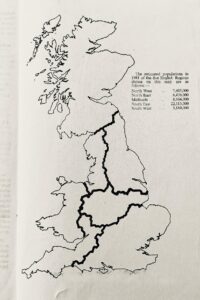
They said: ‘We need in England to rationalise the jungle of boundaries and replace them, if possible, by one standard set of regional boundaries…We need in England to create a centre of power in each region comparable with the Scottish and Welsh Offices…It should be democratic government not bureaucratic government.’
They wanted a scheme that would be uniform across the whole of the UK, with England split into five regions – although they were willing to concede that seven English regions might be necessary. Their proposal for one enormous region for London and the southeast of England, would have included 44% of England’s population, and would surely have exacerbated historical but still fast developing imbalances. (See map) Each region would have a single chamber Assembly of about 100 members, elected by STV.
One of their key aims, was not only to empower regional governments, but also to rejuvenate Parliament. Writing at a time before the creation of the current array of Parliamentary Select Committees, they thought the centre was seriously overloaded and were keen to disempower central government and reduce the size of the civil service. Even with the current level of devolution across the UK, it is difficult to argue that the load on central government is very much less today.
In one sense, their proposals were, perhaps, politically naïve in that they envisaged that ‘freed from local concerns’ MPs would be able to concentrate on national and international matters. This is not how most MPs have ever seen it.
However, their proposals were also an echo of the concerns of another Royal Commission, that on local government in England, chaired by Lord Redcliffe-Maud. Its report, published in 1969, had proposed 58 new unitary authorities, specifically to end ‘the separation of urban areas from their rural hinterlands’. It also proposed eight Provincial Councils for England that would have taken over the functions of the then existing regional economic planning councils. In 1970, the new Conservative government set Redcliffe-Maud aside.
It is interesting that Redcliffe-Maud’s concern ‘to end the separation of urban areas from their rural hinterlands’ – a pre-echo of Crowther-Hunt and Peacock – seems to have no echo in current proposals for devolution in England. It is a weakness of the city-based approach. Even in England, except in the breach, it is not a national plan.
Discussions and debates that drive Wales forward.
Join Wales’ leading independent think tank.
Those sceptical of Burnham’s proposals will argue that the main test will come in defining any fiscal proposals – crucial to defining new institutions as autonomous political authorities rather than delivery agents of central policy. History tells us that the thought of central government in Britain disempowering itself within England is, to say the least, surprising.
We shall see whether old habits die hard – if at all. As the most vulnerable of the three devolved countries, we have a stake in the outcome.
All articles published on the welsh agenda are subject to IWA’s disclaimer. If you want to support our work tackling Wales’ key challenges, consider becoming a member.