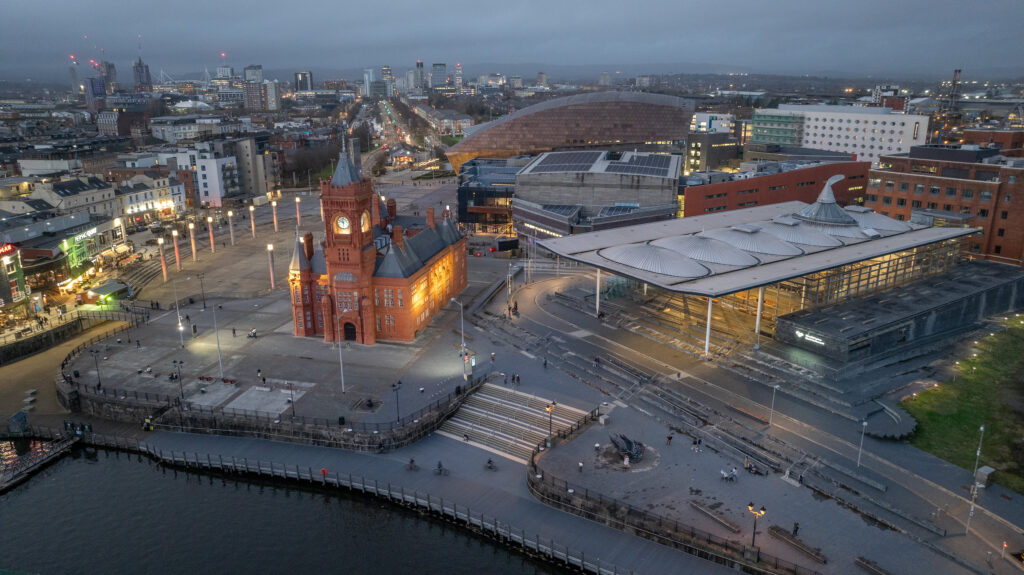
With the political landscape changing through a greater appetite to decentralise power, Chair of Cardiff Capital Region, Cllr Mary Ann Brocklesby, and Chief Executive, Kellie Beirne, argue that Wales should seize the moment to forge a new Welsh way for regional working, and show what makes it such a compelling place to invest.
Today, the political landscape is changing once again. A new Welsh Government is placing greater emphasis on productivity-led economic growth. Westminster is pursuing a programme of state reform and devolution. Across the UK, there is increasing recognition that central government cannot deliver prosperity alone.
That presents Wales with an opportunity, not simply to respond to changes happening elsewhere, but to shape its own future.
The question is no longer whether regions matter. It is how Wales can harness the strengths of nations, regions and local communities together to deliver prosperity that reaches every part of the country.
Innovative. Informed. Independent.
Your support can help us make Wales better.
Regionalism with a purpose
Regionalism should never become an argument about governance structures. The prize is not creating another layer of government. The prize is making a tangible difference to the lives of people who live and work in our communities. Too often, debates about devolution become discussions about institutions rather than outcomes, about who holds power rather than what that power achieves.
The success of regional working must therefore be measured not simply in projects delivered or pounds invested, but in whether it helps tackle the social and economic inequalities that still exist across Wales.
Yet people rarely wake up wondering which tier of government is responsible for a decision. They care about whether they can find a good job close to home. Whether public transport allows them to get to work. Whether their children have opportunity. Whether their town centre is thriving. Whether wages are keeping pace with costs. Whether life feels more secure than it did yesterday. That is why impact must be felt as well as seen.
Economic growth matters. Investment matters. New industries matter. But ultimately, they matter because of what they do for people. The success of regional working must therefore be measured not simply in projects delivered or pounds invested, but in whether it helps tackle the social and economic inequalities that still exist across Wales.
Those inequalities are geographic. They exist between regions, between our towns, valleys and cities. They are also hyper-local. They exist between neighbouring communities, between households and between individuals.
There are communities producing world-leading innovation while other neighbourhoods continue to experience entrenched disadvantage. Some families enjoy increasing prosperity while others struggle with insecurity and rising costs. If growth is not experienced in people’s everyday lives, it remains incomplete.
A new Welsh way of governing
Wales has an opportunity to build something distinctive: a genuine model of multi-level governance rooted in partnership.
The answer is not for national government to do everything. Nor is it realistic to expect local authorities to solve every strategic economic challenge alone. Equally, regions must never become distant bureaucracies standing between decision-makers and communities. Instead, Wales has an opportunity to build something distinctive: a genuine model of multi-level governance rooted in partnership. National government sets the direction, creates enabling frameworks and provides strategic leadership. Regions bring scale, economic intelligence, investment capability and the ability to coordinate across functional economic geographies. Local authorities retain their democratic legitimacy, deep understanding of place and direct relationship with communities. Each level has strengths. Each level depends upon the others.
This is not a zero-sum argument in which one institution gains influence only if another loses it. Stronger regions do not weaken local government. Stronger local government does not diminish the role of national government. The whole becomes greater than the sum of its parts.
Geography does not stop at borders
This matters because economies do not operate neatly within administrative boundaries. Transport links extend across local authority borders. Supply chains flow across regions. People routinely live in one area and work in another. Goods, services, investment, skills and ideas move continuously between communities. The economic geography of South East Wales stretches beyond any one council area and beyond any single regional boundary.
There is a deep-seated nonconformist tradition that challenges hierarchy, values community and believes that people should have a genuine voice in shaping the places where they live.
The same is true across Wales. Regional collaboration allows us to address challenges and opportunities that no individual local authority can tackle alone, while preserving the essential role of councils as the democratic institutions closest to people.
It allows us to build on the strengths of each place and each region to create something collectively stronger. The ambition should not be for regions to compete against one another. Rather, it should be to create strong regional engines connected to one another and aligned with national ambitions. From North Wales to Mid Wales, South West Wales to South East Wales, the goal should be shared prosperity built on complementary strengths. This is how Wales becomes greater than the sum of its parts.
A distinctively Welsh approach
Perhaps more than anything, Wales should approach this challenge in its own way. Our national story is rooted in mutualism, cooperation and collective endeavour. From the miners’ institutes and chapels of the valleys to the market towns, cities, hills and vales of modern Wales, there has long existed a belief that progress comes when people work together rather than apart.
There is a deep-seated nonconformist tradition that challenges hierarchy, values community and believes that people should have a genuine voice in shaping the places where they live. That tradition remains visible today in our approach to social partnership. In Wales, social partnership is not a slogan. It is a bedrock principle. We understand instinctively that lasting progress is built through relationships, trust and collaboration.
Perhaps that is one reason why actor Matthew Rhys’s description of Wales resonates so strongly. We are, as he puts it, ‘a small but mighty nation.’ Small enough to work across boundaries. Mighty enough to achieve far more than our size might suggest.
Discussions and debates that drive Wales forward.
Join Wales’ leading independent think tank.
From empowerment to delivery
The argument for greater regional empowerment is therefore not constitutional for its own sake.
It is practical. It is about ensuring Wales has the tools needed to unlock investment, improve connectivity, support innovation, build skills and grow the economy. It is about giving regions and local authorities the freedoms and flexibilities needed to deliver outcomes and then holding them accountable for results. Most importantly, it is about creating a relationship where Welsh Government, Westminster and UK city regions of local authorities work as partners in national renewal. A partnership relentlessly focused on making a difference. A partnership that recognises prosperity is not an abstract economic concept, but something reflected in the everyday experiences of people and communities.
A partnership rooted in our Welsh way of doing things. Pragmatic rather than ideological. Collaborative rather than competitive. Focused on delivery rather than institutional protection.
The political moment is moving. Across the UK, governments are increasingly recognising the importance of empowered regions. Wales cannot afford simply to observe that debate from the sidelines. We should help shape it. Because the ultimate prize is not a new constitutional settlement. It is a stronger economy. It is reduced inequality. It is opportunity reaching communities that have too often been left behind. It is people feeling the benefits of growth in their homes, workplaces and neighbourhoods. Region and nation working in partnership with local authorities for economic prosperity for everyone.
That is the Welsh way. And Wales should seize the moment.
All articles published on the welsh agenda are subject to IWA’s disclaimer. If you want to support our work tackling Wales’ key challenges, consider becoming a member.