Pwnc Llosg: Safle i herio safonau a sefydliadau trwy gymell dealltwriaeth a chydweithredu. Rydym yn gwneud hyn trwy gynorthwyo lleisiau a llyfrau ledled cymunedau Cymru.
The Context
Much has been made of the Welsh Language and Education (Wales) Act 2025, which is often discussed in conjunction with achieving one million Welsh speakers by 2050. This Act’s primary aim is to ensure that every pupil in maintained schools across Wales is a proficient Welsh speaker upon graduation. I am not writing here to cast a value judgement on this endeavour, but I will propose a few straightforward questions: what will happen to these young Welsh speakers after school? What about language retention?
As a Welsh speaker myself and having gathered the testimony of many others, I believe it’s safe to say that for many of us, especially those from the generation that has rekindled our family ties with the language, Welsh disappears the moment we leave education. Here at Pwnc Llosg, we wondered why not lead by being a bridge (a fo ben, bid bont)? Instead of lamenting the possible blind spots of this Act, why not put our own lived Welsh-speaking experience into practice by creating a space where people can retain or even reclaim their language?
Instead, we believe that through meaningful dialogue and leveraging the expertise of authors, we can translate ideas from the page into actionable steps.
Pwnc Llosg is the Cardiff-based branch of ‘The Reading Room.’. These events are held across the UK to empower communities to advocate for positive social change with a purposeful agenda. These Reading Rooms are not meant to serve as safe spaces and networking hubs like typical book clubs, nor as opportunities to platform authors and sell a few copies. Instead, we believe that through meaningful dialogue and leveraging the expertise of authors, we can translate ideas from the page into actionable steps. As the first Welsh iteration of the Reading Rooms, we felt it was fitting to involve Cymraeg from the outset, thereby encapsulating our branch with the name ‘Pwnc Llosg’ (the Welsh equivalent to ‘hot topic.’
A Welsh Language Philosophy
Languages possess their own inherited philosophies and conceptual frameworks, enabling them to convey epiphanies that others might overlook. Therefore, what I understand in knowing English can sometimes coalesce but often collide with what I grasp in knowing Welsh. As many bilinguals know, there are certain words, ways of feeling, or being that are absent from one language and perfectly expressed in another. Attempting to translate these ideas produces fundamental dislocations, and the magic is lost. As the Italians say, traduttore, traditore (translator, treason) (I am aware of the irony here).
Pwnc Llosg believes that for too long languages have been treated as instruments to be acquired, as tools that do something for us, rather than organisms we live through and with. It is time to return to the broadest sense of language, that is, as the locus of expression. It is also true that when one speaks a language, it is a process of becoming part of a culture, entering communion, and being with others.
Robust debate and agenda-setting research.
Support Wales’ leading independent think tank.
What Pwnc Llosg is suggesting is that we appear to support language equality in Wales. However, in practice, we detach the Welsh language from its expressive act, which is a vital part of Cymraeg. Welsh is no longer Welsh if it is not crafted and performed together, if the entire process of speech is silenced.
Adopting a Cysgod Cymraeg
Ensuring genuine engagement in Welsh at Pwnc Llosg, where most of the audience doesn’t speak Welsh, has presented challenges. Considering this, we have adopted an experimental approach to defining Welsh language involvement. Sessions feature a Cysgod Cymraeg; that is to say, any themes discussed in these sessions are paired with Welsh texts and/or theorists. This does not imply that there should always be Welsh language literature, but rather something resembling an echoing ‘Welsh voice.’ For instance, if Pwnc Llosg is to hold a session on themes in Capitalism, we may wish to introduce the Socialism of Robert Owen. If Pwnc Llosg is to have a session on ‘Feminism,’ we will seek out Welsh Feminist thinkers with a keen interest in entering the space. Although these works may not be written in Welsh, they were conceived in Wales and considered through a Welsh lens.
We also consult Welsh language thinkers (in Welsh) before deciding on themes to ensure continuity in Welsh language literature, which can enrich the events. Achieving linguistic equality should involve embedding Welsh in decision-making and in the ground-level theorising. At each point, Pwnc Llosg asks: ‘What do Wales and Cymraeg think about this?’
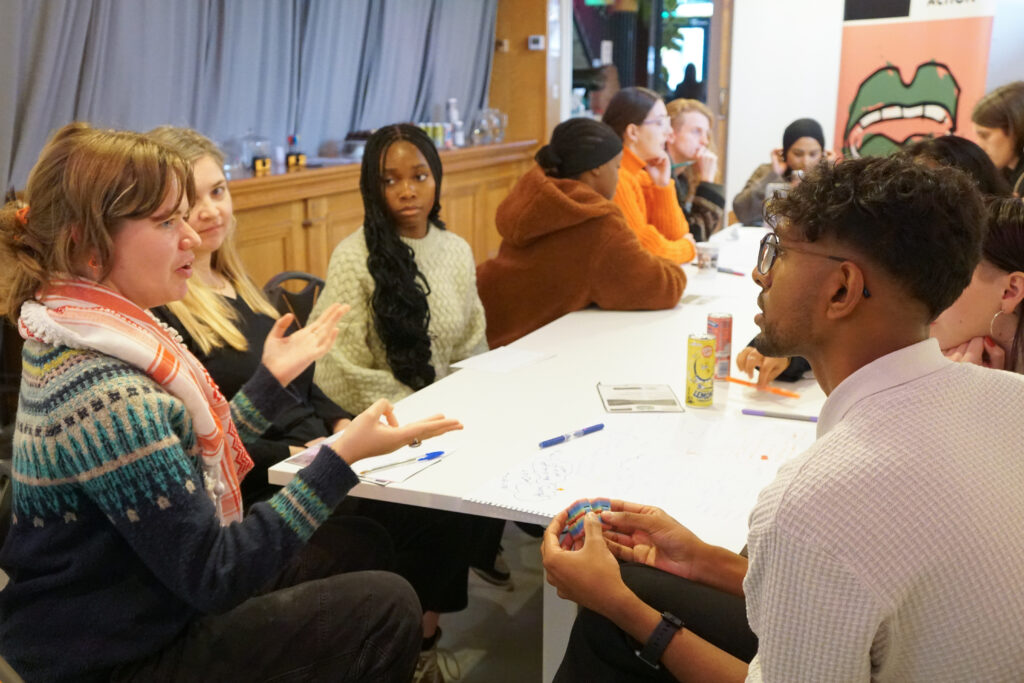
We also tackle the challenge of language inequality in practice or performance. Welsh-speaking participants can discuss in Welsh at our round tables. This could be viewed as Welsh ‘role-playing’ the prevailing status of English. Reversing the power dynamic maximises the minimum position of Welsh.
Event One: Radical Intimacy
Deploying our Cysgod Cymraeg has been quite the success, and this was on show from the outset at our ‘Radical Intimacy’ event with Sophie K Rosa. From the vantage point of Samia Yassine and me, who shadowed this event with background readings and Welsh theorising, the book’s title did not reflect its motives through a Welsh language lens.
Languages possess their own inherited philosophies and conceptual frameworks, enabling them to convey epiphanies that others might overlook.
For instance, in Welsh, we also use the word radical. But really, the word ‘radical’ holds little meaning or practical worth in Welsh. This, we suspect, is because people and ideas labelled radical have often been considered normative ways of life in Wales. Here, I’m thinking of Welsh language speakers today, or, historically, the Chartist and Nonconformist movements. Instead, Samia and I agreed that the term ‘chwyldroadol’ (revolutionary) is primarily used in Welsh and carries clear connotations of action and progress.
In Welsh, ‘intimacy’ too has a unique hue. We would say ‘agos-atrwydd’ or ‘agos-at.’ Taken literally, this means ‘close to.’ This word is used both spatially and metaphorically, essentially meaning that to be intimate, we must get as close as possible to whatever we wish to be intimate with. I interpret this as the point at which the boundary between “I am” and “We are” begins to dissolve. Here, we see that ‘intimacy’ in Welsh functions as an instruction that involves a relationship of proximity, and this relationship is not strictly between people.
Combining the two results, we get ‘Agos-atrwydd Chwyldroadol’ (Revolutionary closeness). This appears less ambiguous, less dialogical, and less romantic to ‘Radical Intimacy.’ The Welsh translation has a stronger collective political resonance. Here we see how a subtle (almost pedantic) shift of words can change the mental imagery and message depending on the lived meaning of the language we use. This changes the way we enter conversations entirely.
Event Two: Uncommon Wealth
The second event, featuring author Kojo Koram, who discussed his book ‘Uncommon Wealth,’ which charts the historical rise and ongoing influence of the British Empire, saw the Welsh shadow used differently. Although we helped position Wales within this broader colonial discourse with Welsh thinkers like Gwyn Alf Williams and Raymond Williams, we were primarily focused on discussing and confronting the fact that, as Welsh speakers, we have never truly been taught our place in the struggle. This was brought about by an interesting discussion with another Welsh language facilitator, Gwernan Brooks.
Discussions and debates that drive Wales forward.
Join Wales’ leading independent think tank.
Because of this, we focused on ensuring that, at the event, Welsh speakers could discuss their opinions on Wales as a colony and as a complicit party in the process of colonisation, in Welsh together. This not only led to fruitful discussion but also allowed us to ask Kojo nuanced questions about Wales. One collective question centred around whether Wales has the right to claim itself as an internal colony, given its insider/outsider status. Kojo then remarked that, of course, it could. The hallmarks of empire are present in Wales, with the extraction of materials and labour which was forced upon the ‘gwerin’ (the folk). It just happens to be that the Welsh nobility, who were a minority, quickly negotiated this tension by submerging themselves in the prestige of the Empire. This, alongside the failure to inform the Welsh of their own history, obfuscates and somewhat skews our positionality.
The Journey for our Welsh language vision is far from over. Evolution is vital for both language and strategy. Any language that refuses to change dies, and any strategy that fails to acknowledge its shortcomings will inevitably fail. The high-octane Welsh historian Gwyn Alf Williams frequently remarked that the Welsh have continually had to reinvent themselves to survive; therefore, Pwnc Llosg’s Welsh language strategy should do the same.
This project would not be possible without the support of TNL Community Fund, TAITH, Pluto Press, Necessity and Arts Active.
The Cysgod Cymraeg evolved through relationships. A conversation with the author during Eric Lesdema’s Arts Council of Wales Llais Y Lle residency hosted by Academi Gymraeg led to Perthyn Project, funded by Cardiff University’s Civic Mission and Public Engagement Progression Fund. The following voices were central to the first iteration of The Cysgod Cymraeg: Einir Siôn, James Eul, Cadi Thomas, Emily Pemberton, Katie Hall, Beli Evans, Ro Barnes, Liam Ellis, Alun Llwyd, Ceri Jones, Huw Williams. The Pwnc Llosg collective meets at Y Lle, with thanks to Catrin Jones, manager of Cardiff University’s Academi Gymraeg (Welsh Language Academy). The library sits inside The Canopi where we host events. A link to the next event with Pwnc Llosg can be found on https://www.pwncllosg.co.uk/.

All articles published on the welsh agenda are subject to IWA’s disclaimer. If you want to support our work tackling Wales’ key challenges, consider becoming a member.