Cai Matthews reflects on how the Welsh rural and agricultural sectors need to be part of the climate conversation
While I am technically a townie (Carmarthen = ‘town’ for the uninitiated), I grew up where most of the land is farmed, and where the distance between policy language and lived reality was something you felt day-to-day, before you could really articulate it. My cousins, my classmates, their families – we understood seasons, harvests, the fragility of it all. What we didn’t understand was why decisions made in Cardiff or London about the future of our communities always seemed to arrive as something done to us, rather than with us.
Dr Helen Tilley’s recent piece in the welsh agenda is one of the better things I’ve read about just transition in Wales. She’s right that net zero is Wales’ economic opportunity, not just its climate obligation. She’s right that structural inequality between regions means a transition designed without equity at its centre will entrench the divides it claims to close. And she’s right that the Well-being of Future Generations Act gives Wales (on paper) a legal framework that most countries are building from scratch.
But her piece points to something it doesn’t fully follow through on, and I think the reason is structural rather than personal. The data, institutions and policy language we’ve inherited make it genuinely difficult to see rural Wales as an economic actor, rather than an economic patient.
What we didn’t understand was why decisions made in Cardiff or London about the future of our communities always seemed to arrive as something done to us, rather than with us.
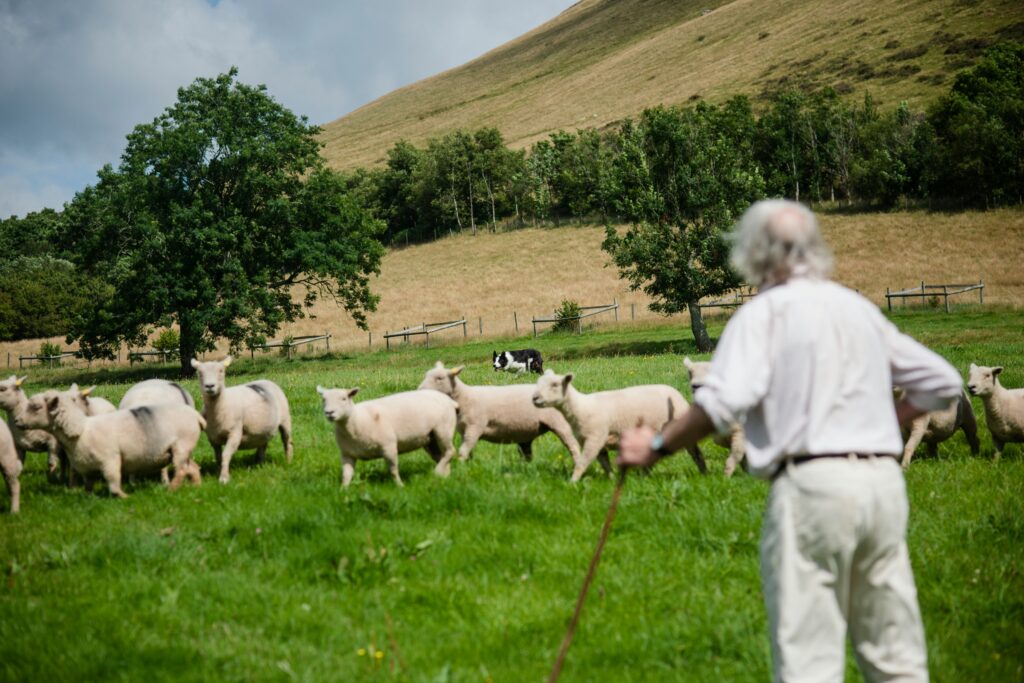
Dr Tilley’s growth sectors for the transition are renewable energy, advanced manufacturing, transport, and digital innovation. These are the right pillars for urban and post-industrial Wales, and her analysis of how to build them equitably is stronger than most of what’s been written on this. But they account for the economic geography of only a fraction of Welsh land. Over 90% of Wales is agricultural or rural. That land, and the people who work it, don’t appear in her economic vision at all. Farmers in Wales are visible in the just transition conversation primarily as potential victims of it, as workers who might need reskilling if their industries change, or relocation if it collapses, as communities who might, in some indirect way, receive the benefits of decisions made elsewhere. They are not framed as producers of economic value in the green economy. They are not framed as innovators. They are not framed as the people who are, right now, tasked with doing some of the most consequential climate work happening on Welsh soil.
I recently attended an IWA webinar titled ‘Delivering a Nature-Positive, Climate-Resilient Economy in Wales’. The panel was excellent. There wasn’t a single farmer, landworker or rural community representative on it.
This is a failure of recognition that seems to run across the Welsh policy conversation, not just in Dr Tilley’s piece. Rural deprivation is geographically dispersed, so it doesn’t produce the visible industrial collapse of Port Talbot, or the political urgency of thousands of workers facing redundancy in a single town. Rather it accumulates quietly: on farms that can’t sustain the next generation, in farm incomes where subsidy consistently exceeds profit, in a mental health crisis that remains structurally invisible in the data that shapes policy, in communities that watch the green economy being built around them while the money, and plaudits, flow elsewhere.
The same land that has been treated as scenery, as ‘hiraeth’ to be printed on a postcard or wrapped up in cotton wool, is actually one of Wales’ most significant socio-economic assets in the transition economy.
The just transition framing, as Dr Tilley lays it out, is essentially government-as-architect. The next Welsh Government invests, coordinates, skills up, sets the vision and bears the burden; communities receive what flows from those decisions. I understand why this framing exists, and the Government has a role, but it’s a framing that has been applied to Welsh rural communities for decades and the results are (in)visible in every agricultural census.
There’s a different way of seeing this. The same land that has been treated as scenery, as ‘hiraeth’ to be printed on a postcard or wrapped up in cotton wool, is actually one of Wales’ most significant socio-economic assets in the transition economy. Welsh agroforestry removes carbon from the atmosphere. Biochar and deep soil addition lock it away durably for centuries. The enhanced wellbeing and biodiversity both generate when deployed in tandem – these are not abstractions. They are actions and assets with quantifiable value in markets that are growing rapidly.
The voluntary carbon market reached $2 billion in 2021. Recently, Microsoft, which represented 90% of global carbon removal purchases in 2025, paused new procurement before reaffirming its long-term commitment. But beneath that headline, something more significant is happening: smaller buyers of high-integrity carbon removal have roughly doubled their purchases every year since 2022, even as the wider market has contracted. The demand that’s growing is demand for quality, and that is precisely where Welsh nature-based systems sit. Welsh farmers could be selling into that market. Most of them aren’t, because the infrastructure to access it equitably doesn’t exist yet.
Innovative. Informed. Independent.
Your support can help us make Wales better.
Building that infrastructure is what I’ve spent the past four years doing, alongside my colleagues at Clo Carbon Cymru. I mention this not to promote it but to make a specific point: we didn’t start with a government contract, target or public sector brief. We started with the observation that Welsh land was well positioned to supply a genuine demand for high-integrity carbon removal, and that every existing mechanism for doing so was designed to extract value from farming communities, not return it. The platform we’ve built keeps the full value chain in Welsh hands, with the Well-being of Future Generations Act at the core of the operating framework. Every participating farm must deliver measurable biodiversity and localised socio-economic improvement as a condition of certification.
I’m not making the argument that carbon markets are a silver bullet for rural Wales. They’re not. No single market is. But a farm that can sell verified carbon removal alongside food production has something most Welsh farms currently don’t: a second revenue stream tied to work they’re already doing on their own land. And while carbon markets have a well-documented value distribution problem; the costs of participation frequently outpace what farmers receive, the policy infrastructure question is precisely about who gets to set the rules. If Welsh farmers participate in carbon markets through platforms designed elsewhere, by people with no stake in Welsh communities, the money flows out. If we build that infrastructure ourselves it doesn’t have to.
This is the argument I want the next Welsh Government to hear. Not simply: invest more in rural Wales. Or: add agriculture to the list of just transition sectors. But: recognise that the architecture of these new markets is being designed as we speak, and Wales has the natural resource capacity, the legal framework, and the genuine innovators to shape it in ways that serve Welsh communities rather than extract from them, for generations to come.
Tilley calls for a clear policy framework and a consistent long-term vision. She’s right, and the question is where that framework gets built. Frameworks like this don’t have to originate solely in government. They can be built by Welsh practitioners, shaped by Welsh values, proven on Welsh land, and handed to the Government as infrastructure that’s already being deployed.
The question for the next Welsh Government isn’t whether it can architect a just transition from the top down. It’s whether it can recognise the one being built from the ground up, and decide to stand behind it.
The Well-being of Future Generations Act was meant to put Wales ahead of the world in joining long-term thinking to practical decision-making. The Senedd’s own Equality and Social Justice Committee is currently conducting post-legislative scrutiny of the Act, examining how far it has been legally binding and enforceable. Part of the answer is already visible in the Act’s own downstream policy: Wales’s Sustainable Investment Principles explicitly require publicly accessible registries for carbon credits, but no public body has yet built one. The best response to the Committee’s scrutiny isn’t another review. It’s recognising and supporting infrastructure that Welsh practitioners are already building to meet the Act’s own demands.
Discussions and debates that drive Wales forward.
Join Wales’ leading independent think tank.
The communities I grew up in didn’t lack capacity or intelligence or understanding of the land. What we lacked was recognition that what we knew had value, and infrastructure that translated that knowledge into a decent living for coming generations to build on. Both of those things can be changed. The question for the next Welsh Government isn’t whether it can architect a just transition from the top down. It’s whether it can recognise the one being built from the ground up, and decide to stand behind it.
All articles published on the welsh agenda are subject to IWA’s disclaimer. If you want to support our work tackling Wales’ key challenges, consider becoming a member.